
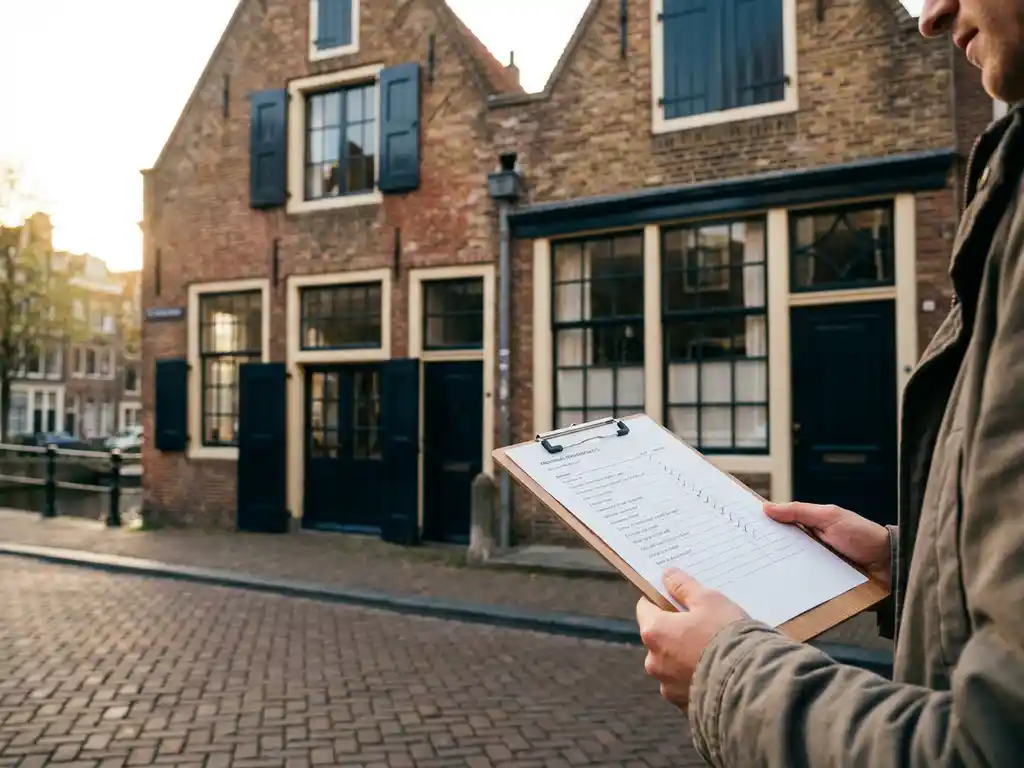
Comparing real estate agents in Amsterdam fairly means looking beyond the commission alone. The combination of demonstrable local market knowledge, transparent pricing, clear communication, and an approach that suits your situation ultimately determines which agent is the best fit for you. In this article, we answer the most frequently asked questions about comparing real estate agents, so you can make a well-informed decision.
What should you look for when evaluating a real estate agent?
When evaluating a real estate agent, focus on five concrete factors: local market knowledge, demonstrable sales results, communication style, transparency about costs, and availability. An agent who knows your neighborhood well understands what buyers are willing to pay and how to position a property to its best advantage. That makes a measurable difference in both the sale price and the time it takes to sell.
At an initial meeting, always ask about recent sales in your area. How many properties has the agent sold in your price range over the past year? What was the average time on the market? Were any properties sold above the asking price? This kind of concrete information tells you far more than a polished pitch during an introductory meeting.
Pay attention to how the agent communicates. Do they respond quickly to your questions? Are their explanations clear and easy to understand, without unnecessary jargon? An agent who keeps you well informed during the exploratory phase will do the same throughout the sales process. That is a reliable indicator of what the working relationship will look like when it really matters.
What is the difference between a buyer’s agent and a seller’s agent?
A buyer’s agent guides buyers through the process of finding and purchasing a property. A seller’s agent supports owners in selling their property. The two roles are opposites: the buyer’s agent represents your interests as a buyer, while the seller’s agent works in the interest of the seller. An agent may never represent both parties simultaneously in the same transaction.
If you want to sell your property, you need a seller’s agent. They develop a sales strategy, set the asking price, handle the presentation, and negotiate on your behalf with interested buyers. If you want to buy a property, a buyer’s agent is invaluable — they help you evaluate properties, submit offers, and protect your interests during negotiations.
In Amsterdam, it is standard practice for both parties to engage their own agent. This gives both buyer and seller the assurance that someone is acting purely in their interest. If you work with an agent who also represents the other party, that protection is absent.
How do you compare agent fees without mixing up apples and oranges?
To compare agent fees fairly, you always need to look at exactly what is included in the fee. A low commission sounds attractive, but if photography, advertising costs, or negotiation support are billed separately, the total amount often ends up being higher. Always compare the full package, not just the percentage.
Most real estate agents in Amsterdam work with a commission: a percentage of the final sale price, typically somewhere between one and two percent. Some agents charge a fixed fee. Neither is inherently cheaper. An agent with a slightly higher commission who demonstrably sells your property for a higher price will net you more than a cheaper agent with a weaker negotiating position.
Use the comparison below as a guide:
- What is included? Ask explicitly about photography, floor plans, Funda listing, viewings, and negotiations.
- Are there setup costs? Some agents charge a fixed upfront fee, separate from the commission.
- What happens if the property does not sell? Are there withdrawal fees?
- How long does the contract run? Do you have the freedom to switch agents if you are not satisfied?
By asking these questions of every agent, you compare offers on the same basis and avoid unpleasant surprises later on.
What are the best questions to ask a real estate agent at an initial meeting?
At an initial meeting with a real estate agent, ask questions that yield concrete answers about experience, working methods, and results. Avoid open-ended questions that invite sales pitches. Instead, ask specific questions that tell you directly what you can expect.
These are the most useful questions to ask:
- How many properties have you sold in my area over the past year? This demonstrates local experience.
- What was the average time on the market and the ratio between asking price and sale price? This gives insight into effectiveness.
- Who will be my dedicated point of contact and how accessible are you? This prevents miscommunication during the process.
- What does your marketing approach look like? Ask about photography, advertising channels, and presentation strategy.
- What will you do if the property has not sold after six weeks? This reveals how proactive the agent is.
- Which costs are included and which are not? This way you avoid surprises on the invoice.
A good agent answers these questions directly and without hesitation. If you receive vague answers or feel that you are not being taken seriously, that is a signal to keep looking.
How reliable are online reviews of real estate agents?
Online reviews of real estate agents are useful as supplementary information, but they should be read critically. Reviews on platforms such as Google or Funda give a first impression, but they do not tell the whole story. A high average rating means little if there are only a handful of reviews, or if all the reviews follow the same generic pattern.
When reading reviews, look for the following signals:
- Specific details: Reliable reviews mention concrete situations, such as how the agent handled a difficult negotiation or how quickly they communicated.
- Variation in tone: If all reviews are nearly identical, this may indicate manipulated ratings.
- The agent’s responses: How an agent responds to critical reviews says a great deal about their professional attitude.
- Recent reviews: Reviews from three years ago are less relevant than recent experiences, as teams and working methods change over time.
Use reviews as one of several sources of information, not as a deciding factor. Personal recommendations from people you trust are generally more reliable than anonymous online ratings.
When is a specialized expat agent the better choice?
A specialized expat agent is the better choice when you are an international property owner looking to sell a home in the Netherlands, or when you are a buyer entering the Dutch real estate market from abroad. The combination of language barriers, unfamiliarity with Dutch laws and regulations, and the complexity of the purchasing process makes guidance from a specialist considerably more valuable than a generalist agent.
For owners who want to sell a property in Amsterdam from abroad, an expat agent offers practical advantages: communication in English, knowledge of international payment processes, and experience with the specific circumstances of non-residents. This includes questions around tax obligations, notarial procedures, and managing matters remotely.
The same applies to international buyers. The Dutch real estate market operates differently from many other countries. Bidding procedures, the role of the notary, and the Funda system are unfamiliar territory for many expats. An agent who works with international clients every day understands that context and tailors their guidance accordingly.
How we help you sell your property
At Urban Homies, we guide property owners from start to finish through the sale of their home in Amsterdam and the surrounding area. Our approach is concrete and personal: you are assigned a dedicated homie as your point of contact, someone who knows your situation and keeps you actively informed throughout the entire process.
What we do as your seller’s agent in Amsterdam:
- Valuation: We thoroughly analyze the market and establish a realistic and competitive asking price.
- Tailored marketing strategy: Professional photography, a compelling listing, and targeted distribution through the right channels.
- Negotiations: We represent your interests on every offer and throughout every negotiation.
- End-to-end guidance: From the first conversation to the transfer of keys and the aftercare that follows.
We also work with notaries, lawyers, and mortgage advisors for personalized tax and legal advice. Whether you live in Amsterdam or want to sell your property from abroad, we handle the entire process. Get in touch for a no-obligation introductory conversation.