
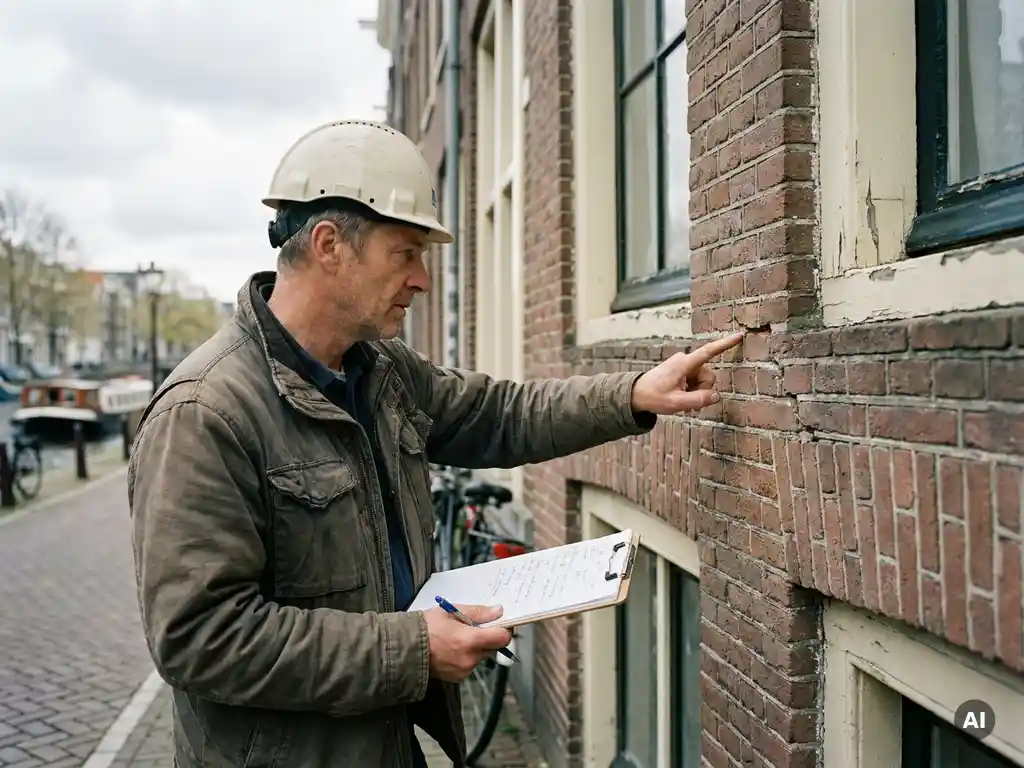
A structural survey is worthwhile when making an overbid, even if you waive a financing contingency in the process. The survey gives you insight into the technical condition of the property before you enter into a binding commitment. Whether it is a wise move depends on the age of the property, the visible state of maintenance, and the size of your bid.
In a competitive market like Amsterdam, buyers sometimes choose to drop the structural survey as a contingency in order to make a more attractive offer. But that does not mean you should skip the survey itself. The questions below help you make a well-considered decision.
What happens if you overbid without a structural survey?
If you overbid without a structural survey, you are buying the property without objective insight into its technical condition. You have no contingency based on structural findings, which means you cannot back out of the purchase if defects come to light afterwards. You are fully bound by your offer.
This carries a concrete financial risk. Hidden defects such as wood rot, roof leaks, foundation problems, or asbestos can surface after the transfer. The repair costs then fall entirely on your shoulders. In theory you can hold the seller liable for hidden defects, but that requires legal action and is rarely straightforward.
Moreover, when overbidding you are already paying more than the asking price. If unexpected repair costs are added on top of that, the total investment can end up significantly higher than you budgeted for. Without a survey, you simply lack the information needed to properly assess that risk.
When is a structural survey mandatory or strongly recommended?
A structural survey is not legally required in the Netherlands when purchasing a property. Nevertheless, mortgage lenders and buying agents strongly recommend a survey for properties built before 1990, where there is visible deferred maintenance, or where the property has a special construction such as a wooden foundation or a flat roof.
There are situations in which a survey is particularly relevant:
- Older properties (pre-1975): higher likelihood of asbestos, outdated installations, and foundation problems
- Properties that have been vacant for a long time: hidden moisture problems and mold are difficult to spot during a viewing
- Properties with visible deferred maintenance: the survey reveals the full extent of the issues
- New-build properties with a snagging list: these require a specific handover inspection that follows different rules
Some mortgage lenders make the survey a condition for granting a mortgage, particularly for properties with a lower market value or special characteristics. Always check this with your mortgage advisor before submitting an offer.
How do survey costs compare to potential repair costs?
A structural survey typically costs between €300 and €600, depending on the size and complexity of the property. That amount is small compared to the repair costs a survey can uncover. Roof replacement, foundation repair, or asbestos remediation can quickly run into tens of thousands of euros.
The calculation is straightforward. If a survey reveals a serious defect requiring €15,000 in repairs, you have avoided a costly surprise for €400 in survey fees. That is no guarantee that something will always be found, but it is a deliberate risk assessment.
In addition, you can use the survey results as a negotiating tool, even when overbidding. If the survey reveals defects, you may in some cases still be able to discuss a price adjustment with the seller, or reconsider your decision if the contingency is still in effect. Without a survey, you simply do not have that information.
Can a structural survey influence your bidding strategy?
Yes, a structural survey can directly influence your bidding strategy. If the survey reveals no major defects, you can make a strong offer with greater confidence. If defects are found, you know exactly which repair costs to factor into your bid, so you do not overpay for a property with deferred maintenance.
There are two moments at which you can use the survey:
- Before the offer, as a contingency: you bid subject to a satisfactory structural survey. This protects you, but makes your offer less attractive in a market where sellers prefer certainty.
- Before the offer, without a contingency: you have the survey carried out before the bidding deadline and then submit an offer without conditions. This requires speed and sometimes the cooperation of the selling party.
In a market where overbidding is the norm, more and more buyers are opting for the second approach. You give the seller certainty, while you yourself have the information you need to make a responsible offer.
What are the alternatives to a full structural survey when overbidding?
If a full structural survey is not feasible due to time constraints or competition, there are lighter alternatives that still provide useful information. They do not replace a full survey, but they reduce the risk of making an offer with no technical information at all.
A visual inspection by a structural expert
A structural expert can accompany you during the viewing and visually assess the property without extensive measurements. This takes less time than a full survey and gives you a general picture of the condition of the roof, foundation, facades, and installations. The costs are lower and the turnaround time is shorter, making it suitable for a tight bidding deadline.
Requesting existing survey reports
Some sellers commission a structural survey themselves before putting the property on the market. Ask the selling agent whether such a report is available. Bear in mind: this report was drawn up on behalf of the seller, which means you should read the findings critically and, if necessary, have them explained by an independent structural expert.
An NHG appraisal with technical assessment
For properties that qualify for the Nationale Hypotheek Garantie (NHG), the appraisal sometimes includes a basic technical assessment. This is not a substitute for a survey, but gives the mortgage lender and you a minimal picture of the condition of the property.
How we help you buy a property in Amsterdam
At Urban Homies we guide buyers from the first exploratory conversation through to the key handover at the notary. We map out your requirements via a video call, analyze the property file, organize viewings, and draw up a personalized offer that matches market conditions. We also handle all communication with the selling agent, appraiser, structural inspector, and notary, so you do not overlook anything.
Specifically when it comes to questions about overbidding and structural surveys, we actively think along with you about your bidding strategy. We help you determine when a survey in advance is worthwhile, what risks you take without contingencies, and how you can still make a strong offer without taking unnecessary risks. Our buying guidance is available for both Dutch and international buyers in Amsterdam and the surrounding area. Would you like to know what we can do for you? Contact us and we will schedule a no-obligation consultation.