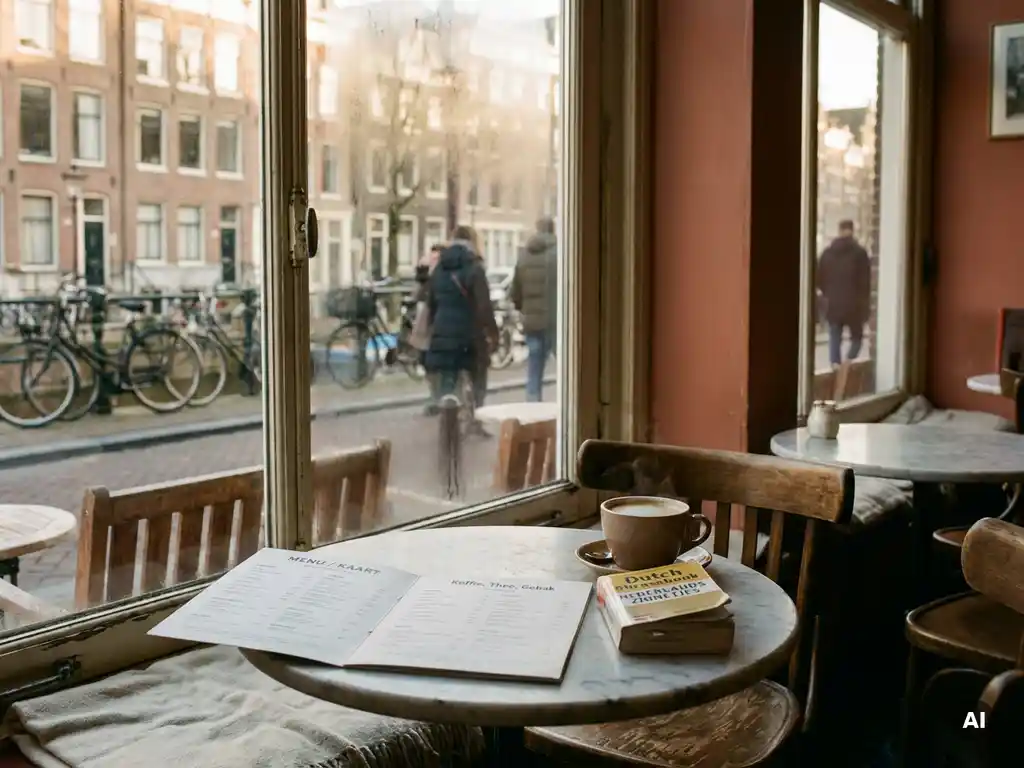
You don’t necessarily need to speak Dutch to live in the Netherlands. In major cities like Amsterdam and Rotterdam, you can get by in daily life with English, and many expats live here for years without fully mastering the language. Still, a basic knowledge of Dutch makes your life considerably easier, especially outside the major cities or when dealing with government agencies. In this article, we answer the most frequently asked questions about language, work, residence permits, and living in the Netherlands.
How well do you need to speak Dutch to manage your daily life?
For daily life in the Netherlands, you don’t need fluent Dutch. In cities like Amsterdam and The Hague, staff at most shops, restaurants, hospitals, and service counters speak fluent English. You can do your grocery shopping, make a doctor’s appointment, and use public transport without speaking a single word of Dutch.
Outside the Randstad, it gets a little trickier. In smaller towns and villages, English proficiency is less of a given. Here you’ll notice that a few basic phrases in Dutch really help when making connections and handling practical matters. Think about picking up a package, chatting with neighbors, or contacting the local municipality.
Practically speaking, there are a few situations where you’ll encounter some Dutch:
- Official letters from the municipality, the Tax Authority, or your health insurer are often in Dutch
- Some forms at government agencies aren’t always available in English
- Parent evenings at schools or neighborhood meetings are often conducted in Dutch
Fortunately, many translation tools are available for those situations, and you can always ask someone for help. The barrier is low, but some familiarity with the language makes your daily life more comfortable.
Need a local Homie?
Share your plans with us and discover how we can help with your home, move or relocation in the Netherlands.
Is English enough to work in the Netherlands?
In many sectors, English is more than enough to work in the Netherlands. The Dutch labor market is internationally oriented, and in tech, finance, logistics, and the creative industry, many teams operate entirely in English. Amsterdam attracts international talent, and many employers expect this as well.
Whether English is sufficient depends heavily on your field and employer. At multinationals, international startups, and scale-ups, English is the working language. At companies that primarily serve Dutch customers, such as retail, healthcare, or education, Dutch is often expected.
A few general rules of thumb:
- Tech and IT: English is the standard, even at Dutch companies
- Finance and consulting: English is widely accepted, especially in international teams
- Healthcare and education: Dutch is almost always required
- Customer service: depends on the customer base, but Dutch is a strong advantage
- Freelance and remote work: entirely dependent on your clients
In the long run, learning Dutch expands your opportunities in the labor market, but it’s certainly not a hard requirement to get started with many international employers in the Netherlands.
What are the official language requirements for a residence permit in the Netherlands?
For most residence permits in the Netherlands, there are no direct language requirements. If you apply for a work visa, a highly skilled migrant permit, or a Blue Card, language proficiency plays no role in the assessment. The requirements revolve around your employment contract, salary, and qualifications.
Language only becomes relevant when you want to apply for permanent residency or Dutch citizenship. For a permanent residence permit (indefinite residence permit), you must demonstrate that you have passed the civic integration exam or have been granted an exemption. This exam includes, among other things, a language test at level A2 or B1, depending on the route.
For naturalization — that is, becoming a Dutch citizen — the bar is higher: you need a certificate at a minimum level of B1 and must demonstrate that you are sufficiently integrated into Dutch society.
What is civic integration and who is required to complete it?
Civic integration is the official integration process that newcomers in the Netherlands go through to learn the language and become familiar with Dutch society. The civic integration exam consists of several components, including language proficiency, knowledge of Dutch society, and labor market orientation.
Not everyone is required to complete civic integration. The civic integration obligation applies to people who:
- Were born outside the EU
- Hold a residence permit based on family reunification, asylum, or humanitarian grounds
- Are older than 16 years of age
Exempt from civic integration are, among others, EU citizens, highly skilled migrants with temporary residence, and people who already hold a diploma from a Dutch-language educational institution. Expats who come to the Netherlands through their employer and hold a highly skilled migrant permit are also, in most cases, exempt from the civic integration obligation.
Those who are required to complete it have three years from 2026 to pass the exam. The municipality assists by offering courses and guidance. Those who ignore the obligation risk a fine or consequences for their residence permit.
How quickly can you learn Dutch as an expat in Amsterdam?
How quickly you learn Dutch as an expat in Amsterdam depends on your native language, the time you invest in it, and how consciously you apply the language in your daily life. On average, it takes six to twelve months to develop a basic understanding with regular study, but many people take longer because the temptation to simply continue in English is strong.
That is precisely the paradox of Amsterdam: everyone speaks such good English that you feel little pressure to learn Dutch. This makes the city comfortable for expats, but it also slows down the language acquisition process.
What does help to make faster progress:
- Taking a language course with an accredited provider, including online
- Consuming Dutch-language media, such as podcasts, news, or series
- Consciously choosing to speak Dutch in shops or with neighbors, even when they switch to English
- Finding a tandem partner who speaks Dutch and wants to learn your native language
- Enrolling your children in a Dutch-language school, which also forces you to pick up the language
For speakers of German, Swedish, Danish, or other Germanic languages, the process is relatively quick. For speakers of non-Germanic languages, it generally takes more time, but even then a functional level is achievable within one to two years with sufficient practice.
Do you need to speak Dutch to rent or buy a home in the Netherlands?
No, you don’t need to speak Dutch to rent or buy a property in the Netherlands. In the major cities, many real estate agents, landlords, and property professionals work in English, especially in Amsterdam where demand from international renters and buyers is high. Rental contracts are sometimes drawn up in Dutch, but you can always ask for a translation or explanation.
When renting a property as an expat, you may sometimes encounter language barriers. Official documents such as the rental contract, the general terms and conditions, or correspondence with the VvE (Homeowners’ Association) are often in Dutch. It is then useful to have someone look through these documents for you and explain what you are signing.
When buying a property, language plays a bigger role. The notarial deed, the purchase contract, and mortgage documents are legally required to be in Dutch. However, a notary is obliged to explain the contents, and you are allowed to bring an interpreter. Many notaries in Amsterdam also offer English-language guidance.
How we help you relocate to the Netherlands
Moving to the Netherlands goes beyond finding a home. Language barriers, legal documents, government registrations, and immigration procedures can be overwhelming, especially if you’re doing this for the first time in a new country. Urban Homies guides you from the first contact abroad to the moment you are fully settled in your new home.
We handle the entire process for you, including:
- Property search and viewings, entirely in English
- Review and explanation of the rental contract, so you know what you’re signing
- Municipal registration and BSN application
- IND procedure and Blue Card application for non-EU expats
- Connection of utilities and a welcome package upon arrival
Do you have questions about moving to Amsterdam or would you like to know what we can do for you? Get in touch and your personal Homie will be happy to help.
Need a local Homie?
Share your plans with us and discover how we can help with your home, move or relocation in the Netherlands.