
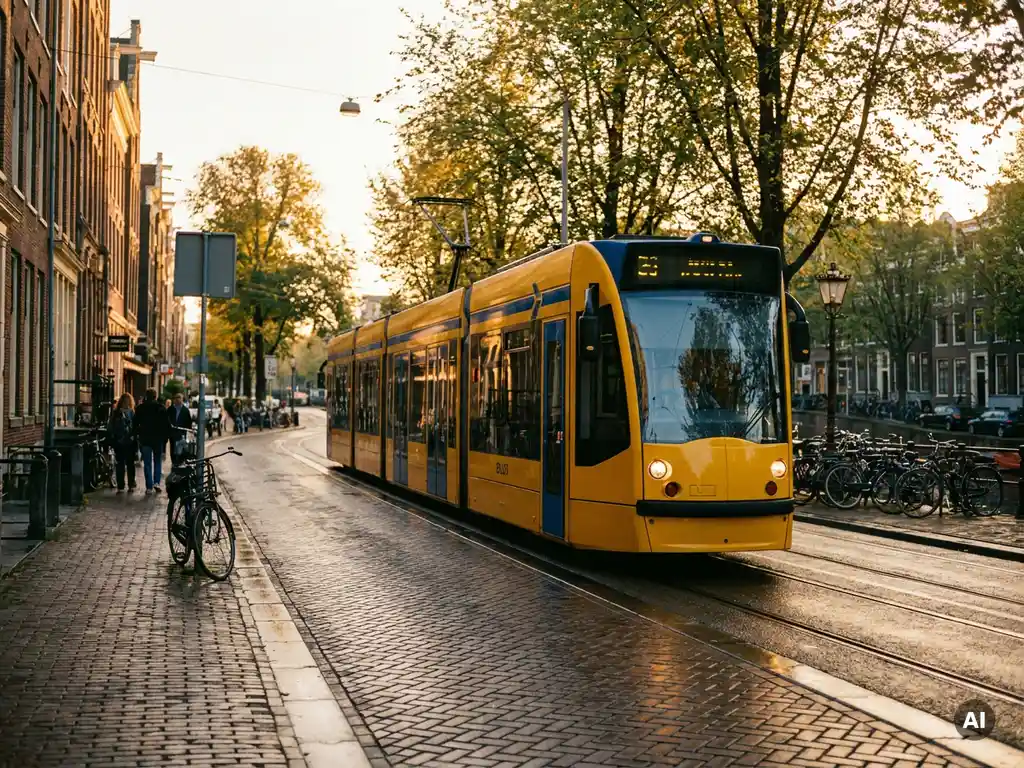
Public transport in the Netherlands operates through an integrated network of trains, trams, metros, buses, and ferries. You pay with a single system: the OV-chipkaart. With it, you travel throughout the entire country, regardless of which carrier you use. In this article, we answer the most frequently asked questions about Dutch public transport, so you as a newcomer can get started right away.
Which modes of transport are part of public transport in the Netherlands?
Public transport in the Netherlands includes trains, trams, metros, buses, and ferries. NS (Nederlandse Spoorwegen) operates the national train network. Regional transport, such as buses and trams, is provided by carriers like GVB (Amsterdam), RET (Rotterdam), HTM (The Hague), and Connexxion.
In Amsterdam, you travel daily by:
- Trams through the city center and neighborhoods
- Metro for faster connections between city districts
- Buses for routes outside the tram network
- Ferries free of charge across the IJ to Amsterdam-Noord
- Intercity trains to Amstelveen, Haarlem, Almere, and the rest of the Netherlands
All these modes of transport work together in one system. You use the same OV-chipkaart for every mode of transport, regardless of the carrier. This makes transferring simple and straightforward.
Need a local Homie?
Share your plans with us and discover how we can help with your home, move or relocation in the Netherlands.
How does the OV-chipkaart work?
The OV-chipkaart is a rechargeable payment card that you check in with when boarding and check out with when alighting. The system automatically calculates the travel costs based on your route. If you fail to check out, you pay a fine or a maximum fare, so this is something to pay close attention to.
There are three types of OV-chipkaart:
- Personal OV-chipkaart: registered to your name, linked to a subscription or travel product. If you lose it, you can have the balance restored.
- Anonymous OV-chipkaart: not registered to a name, available for purchase at supermarkets and NS stations. Useful as a temporary solution.
- Disposable card: a single-use paper card for short journeys, available from machines at larger stations.
You top up the card via machines at stations, through the NS app, or online. For the train, you must have a minimum balance of 20 euros to be able to check in. For trams and buses, a lower minimum amount applies. Always check this in advance to avoid unpleasant surprises.
Since 2023, more and more carriers also accept payments with a debit card or credit card via contactless payment. Nevertheless, the OV-chipkaart remains the most reliable option for daily travelers.
What does public transport cost in the Netherlands?
The cost of public transport in the Netherlands depends on the distance and the mode of transport. Trains charge per kilometer, while urban transport such as trams and metros works with a boarding fee plus a rate per zone or distance. For daily commuters, costs can add up quickly.
A few indicative prices for 2026:
- Train boarding fee: approximately €1.00, followed by a rate per kilometer
- Tram or metro ride in Amsterdam: from approximately €1.10
- NS off-peak or weekly subscription: offers a 40% discount outside rush hours
- OV annual card: the most cost-effective option for frequent travelers
If you commute by train daily as an expat, it is worth taking out an NS Flex subscription. With it, you only pay for the journeys you make, with automatic discounts during off-peak hours. Compare this with a fixed route pass if you always travel the same route. That can work out considerably cheaper, especially when searching for a home within commuting distance of your work.
How do you plan a public transport journey in the Netherlands?
The easiest way to plan a public transport journey is via the 9292 app or the website 9292.nl. This planner combines all carriers in the Netherlands and gives you the fastest or cheapest route, or the route with the fewest transfers. The NS app also works well, but only for train journeys.
Step by step to plan a journey:
- Open 9292.nl or the 9292 app
- Enter your departure point and destination
- Choose your desired departure time or arrival time
- View the route options and choose the most suitable one
- Check for disruptions via the NS app or your carrier’s website
Google Maps also works reliably in the Netherlands for public transport routes and is handy if you are already used to that interface. For real-time delays and disruptions, we recommend the official apps, as these are updated more quickly.
What are the rules and etiquette in public transport?
In Dutch public transport, a number of fixed rules and unwritten social norms apply. The most important formal rule: always check in and check out with your OV-chipkaart. If you do not, you pay a fine. Inspectors travel regularly and actively check.
Other rules and customs to be aware of:
- Quiet compartment on the train: specific carriages on the train are designated as quiet compartments. Phone calls and loud conversations are not permitted there.
- Bicycles on the train: permitted outside rush hours, but you need a separate bicycle ticket.
- Priority seats: give up your seat to elderly people, pregnant women, and people with disabilities.
- Eating and drinking: permitted, but keep it tidy and clean up after yourself.
- Headphones: always use headphones when listening to music or watching videos.
Dutch people are generally quiet on public transport. Loud conversations stand out and are not appreciated. Keep this in mind, especially on the train.
Is public transport in the Netherlands reliable for daily commuters?
Public transport in the Netherlands is reliable for most daily routes, but not flawless. At NS, on average around 85 to 90 percent of trains run on time, which means delays occur regularly, particularly during rush hours or due to technical failures and weather conditions.
For daily commuters, the following factors are relevant:
- Busy routes such as Amsterdam Centraal to Utrecht or Schiphol regularly experience delays
- Regional buses are generally more punctual than the train on busy routes
- Urban transport in Amsterdam (tram, metro) usually functions well, but can be disrupted by roadworks
- Planning alternative routes via 9292 helps when your main route fails
If you are considering commuting from a city like Haarlem or Almere to Amsterdam, public transport is a realistic option. The connections are frequent and the travel times are acceptable. Do allow for some flexibility in your planning, especially in the first weeks after your move.
How we help with your move to the Netherlands
Moving to the Netherlands means more than just finding a home. You navigate a new transport system, a new neighborhood, and a range of practical matters that all come at you at once. We understand this and guide you through every step of the process. From finding a home in a convenient location relative to your work to arranging your municipal registration, BSN application, and for non-EU expats also the IND procedure.
At Urban Homies, you are matched with a personal homie, a local expert who knows your situation and helps you settle quickly and confidently. We work together with notaries, lawyers, and mortgage advisors and offer a complete package of expat housing services, tailored to your needs. Want to find out what we can do for you? Contact us for a no-obligation introductory conversation.
Need a local Homie?
Share your plans with us and discover how we can help with your home, move or relocation in the Netherlands.