
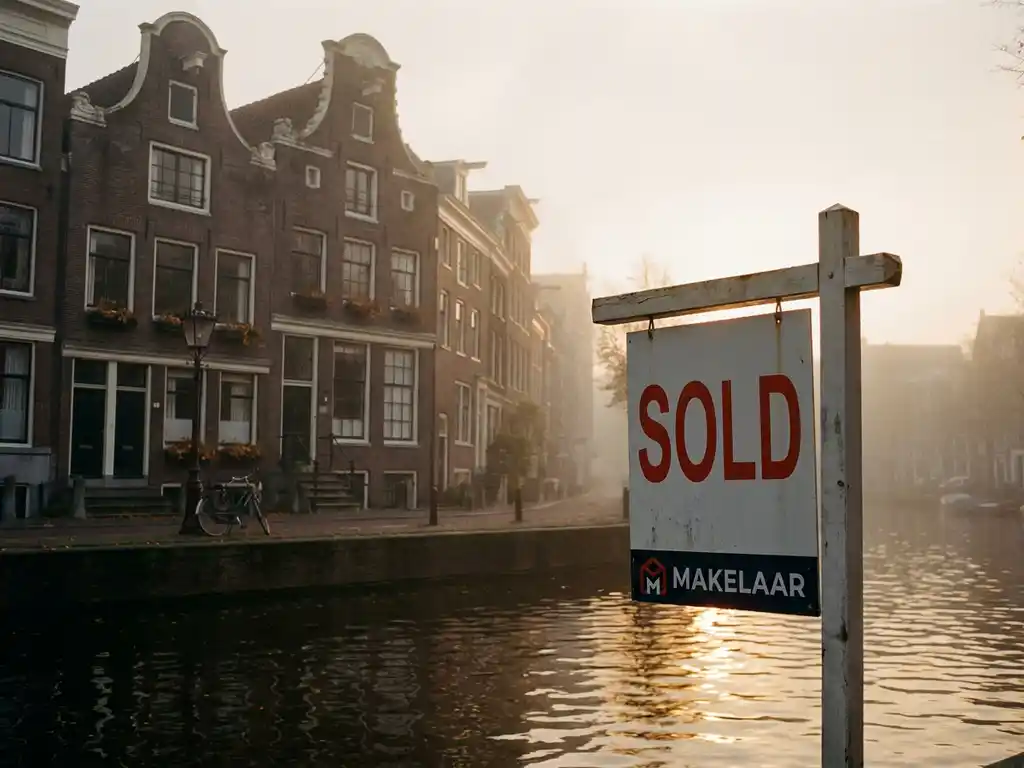
A sold property remains visible on Funda for an average of a few weeks to several months after the sale. The exact duration depends on the stage of the sales process: is the property listed as ‘sold subject to conditions’ or definitively ‘sold’? After the final transfer at the notary, the listing is typically removed within a few weeks. In this article, we answer the most frequently asked questions about property sales and Funda, so that as a buyer you know exactly what you’re seeing and how to use that information wisely.
How long does a property stay listed as ‘sold’ on Funda?
A property with the status ‘sold’ on Funda remains visible for an average of two to six weeks after the final transfer at the notary. The selling agent decides when the listing is removed. There is no legal deadline, which means the visibility period can vary from one agent to another.
In practice, many agents leave the listing up for a while, as Funda uses the sales data for its own statistics and market overviews. Once the transaction is complete and the keys have been handed over, the listing no longer serves any commercial purpose. Even so, it sometimes takes longer for a listing to disappear, simply because manual removal doesn’t always get immediate attention.
As a home buyer, it’s useful to know that a property with the status ‘sold’ on Funda is no longer available. You can no longer place a bid on it. What you can do is use the sales information as a reference for comparable properties in the area — something we explain further on in this article.
What is the difference between ‘sold’ and ‘sold subject to conditions’ on Funda?
‘Sold subject to conditions’ means that a purchase agreement has been signed, but the sale is not yet final. ‘Sold’ means that all conditions have lapsed and the transfer at the notary has taken place or is imminent. The distinction is legally and practically important for buyers who are following the market.
With ‘sold subject to conditions’, the most common conditions are:
- Financing condition: the buyer has not yet received final mortgage approval
- Structural survey condition: a structural inspection is still being carried out
- Sale of own property condition: the buyer must first sell their own home
As long as a property is listed as ‘sold subject to conditions’, there is theoretically still a small chance that the deal will fall through. In practice, the vast majority of transactions at this stage proceed without issue. Nevertheless, it may be worth other interested buyers contacting the agent, in case the purchase is ultimately cancelled.
Once all conditions have lapsed, the status changes to ‘sold’. The notarial transfer then follows, after which the property formally changes ownership.
Why is a sold property sometimes still visible on Funda for weeks?
A sold property sometimes remains on Funda for weeks because agents must remove the listing manually and there is no fixed deadline for doing so. Funda does not automatically remove listings after transfer. The agent is responsible for keeping the status up to date and eventually taking the listing offline.
There are a few practical reasons why this gets delayed:
- The notarial transfer and the updating of the listing don’t always happen on the same day
- Busy agents sometimes schedule administrative tasks such as removing listings for a later date
- Funda uses the sales data internally, meaning the information remains available for statistics purposes for some time
As a buyer, you don’t need to be misled by this. A property with the status ‘sold’ is simply no longer for sale, even if the listing is still showing. It’s better to use the visible information as market data rather than as a reason to reach out about a purchase.
Can a buyer find the sale price of a property on Funda?
Yes, the sale price of a property can be found on Funda, but only for users with a paid Funda account. Through Funda Pro or a subscription to Funda’s sales data, you can view historical sale prices for properties in a specific street or neighbourhood. Without a subscription, you can only see the former asking price.
If you don’t have a paid account, there are other ways to obtain sale prices:
- The Land Registry (Kadaster): all property transfers are recorded and can be requested publicly through the Kadaster. You pay a small fee per request.
- NVM statistics: the Dutch Association of Real Estate Agents publishes quarterly reports with average sale prices by region.
- Your own agent: a buyer’s agent typically has access to more extensive market data and can provide you with concrete comparable figures.
For home buyers who are negotiating seriously, access to sale prices of comparable properties is extremely valuable. It gives you a realistic picture of what a property is actually worth, independent of the asking price set by the seller.
How do you use Funda sales data as a home buyer?
As a home buyer, the best way to use Funda sales data is as a reference point for making a fair offer. By looking at what comparable properties in the same neighbourhood have sold for, you can better assess whether an asking price is realistic and what a strong opening offer would be.
Here’s how to put Funda sales data to practical use:
- Search for comparable properties: filter by the same neighbourhood, property type, floor area, and year of construction to make a fair comparison.
- Look at the ratio between asking price and sale price: if properties in the area are consistently selling above the asking price, you’ll know that you’ll likely need to bid above asking.
- Pay attention to time on the market: properties that were listed for a long time before selling may have gone for less than the asking price. This can be a signal that there is room to negotiate.
- Combine Funda data with Land Registry information: this gives you the most complete and up-to-date picture of the market.
Bear in mind that Funda sales data is a snapshot in time. The housing market can move quickly, especially in cities like Amsterdam, Amstelveen, and Haarlem. Sale prices from six months ago are less representative than recent transactions.
How we help with buying a property
Funda gives you an initial overview of the market, but moving from searching to actually buying requires more than data alone. At Urban Homies, we guide you through the entire purchase process — from interpreting market information to negotiating the best price and arranging the notarial transfer.
What we do for you:
- Valuation and market analysis of the property you have in mind
- Support in formulating a strong and realistic offer
- Guidance through the structural survey and financing condition
- Personal contact with a dedicated ‘homie’ who represents your interests
- Collaboration with notaries and mortgage advisors for legal and financial advice
Want to find out what we can do for you when it comes to buying or selling a property? Get in touch with us and we’ll look at your situation together.