
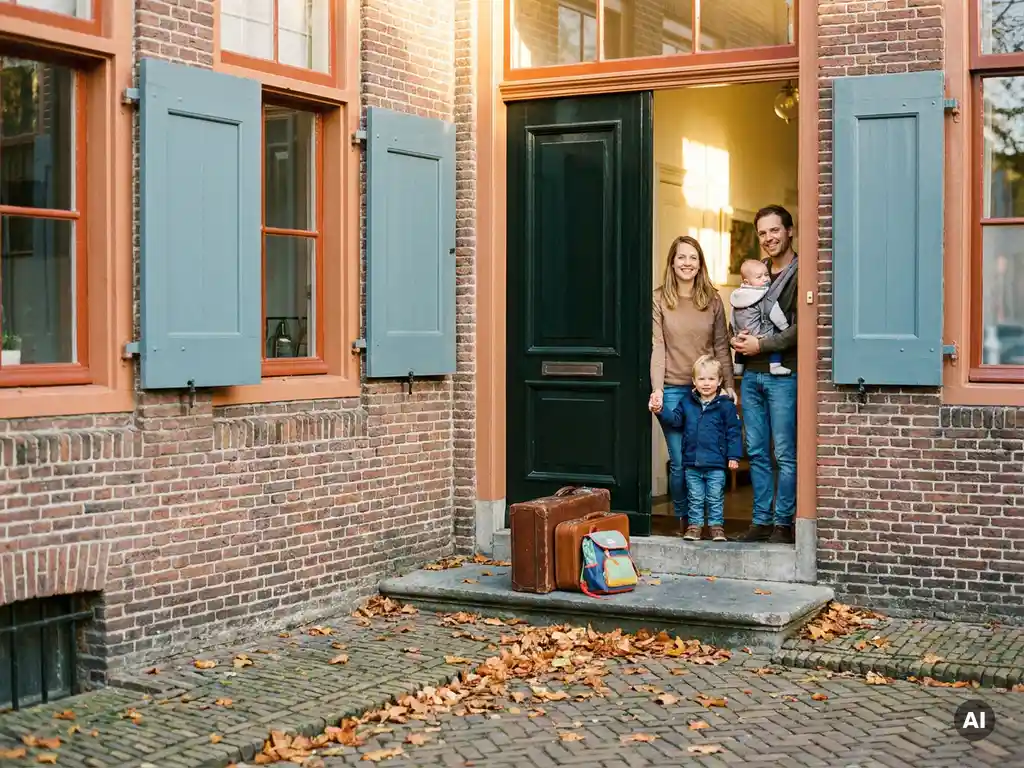
If you are moving to the Netherlands with children, there are several things you need to arrange: municipal registration, a BSN number, school enrollment, childcare, and health insurance. Most of these steps are interconnected and follow a logical order, with municipal registration serving as the starting point. In this article, we answer the most frequently asked questions from expats moving to the Netherlands with their family.
What documents do you need for your children upon arrival in the Netherlands?
For your children, you will need at least the following documents upon arrival in the Netherlands: a valid passport or identity document, a birth certificate (preferably with an apostille), and if applicable, a visa or residence permit if you live outside the EU. These documents are used for municipal registration, school enrollment, and health insurance.
Non-EU citizens also need a valid residence permit for each family member, including children. The IND (Immigration and Naturalisation Service) handles these applications. Keep in mind that foreign documents sometimes need to be officially translated and legalized before Dutch authorities will accept them. This applies in particular to birth certificates from countries outside the EU.
Always keep multiple copies of all documents, both digitally and physically. You will need them at multiple stages, and having them readily available saves time.
Need a local Homie?
Share your plans with us and discover how we can help with your home, move or relocation in the Netherlands.
How do you register your children with the municipality in the Netherlands?
You register your children with the municipality by going to the town hall of the city or municipality where you will be living, together with your children. Children are automatically registered as part of the family as soon as you register as a parent. After registration, your children will also receive a BSN number (citizen service number), which is required for school, healthcare, and other official matters.
For registration, you need proof of your home address, such as a rental contract. Without a valid address, you cannot register. This is one of the reasons why finding housing as soon as possible after arrival is so important. Municipalities work by appointment, so plan this in good time.
Once registration is complete and the BSN has been applied for, it opens the door to virtually all other steps: school enrollment, health insurance, and childcare allowance.
How do you find a good school for your children in the Netherlands?
You can find a good school for your children by looking at the type of education that suits your family situation and length of stay. In the Netherlands, you can choose between regular Dutch schools, international schools, and bilingual schools. Regular schools are free and operate entirely in Dutch; international schools offer education in English or another language but often come with high costs.
Regular Dutch schools
If you plan to stay in the Netherlands for a longer period, a regular school is often the best choice for integration. Many primary schools offer NT2 education (Dutch as a second language) for children who do not yet speak the language. You enroll your child at the school of your choice, but be aware of waiting lists, particularly in major cities such as Amsterdam.
International schools
For families who are temporarily living in the Netherlands or whose children are already accustomed to international education, international schools offer a logical choice. The most well-known system is the International Baccalaureate (IB). Costs vary but can run into thousands of euros per year. Some employers cover these costs as part of an expat package.
What are the childcare options in the Netherlands for expats?
As an expat, you have access in the Netherlands to the same childcare options as Dutch parents: day care for children aged 0 to 4, after-school care (BSO) for primary school-aged children, and family day care. If you both work and pay taxes in the Netherlands, you may also be entitled to childcare allowance through the Tax Authority.
Waiting lists for childcare in major cities are long. In Amsterdam, the waiting time can be a year or more. It is therefore advisable to register your child as early as possible, even before your arrival in the Netherlands. Always ask about rates, opening hours, and whether the childcare provider is registered in the National Register of Childcare (LRK) when enrolling. Only registered childcare entitles you to an allowance.
Is your child entitled to Dutch health insurance as an expat?
Children under 18 who live in the Netherlands and are registered with the municipality are covered for free under a parent’s basic insurance. You do not need to take out separate health insurance for your children. As soon as you, as a parent, have health insurance, your children are automatically covered for basic healthcare.
As an employee in the Netherlands, you are required to take out basic insurance within four months of registering with the municipality. Failing to do so risks a fine. For supplementary care, such as dental or physiotherapy, you take out supplementary insurance. Children can also be included in supplementary coverage, depending on the policy.
Non-EU expats who are still waiting for their residence permit can temporarily make use of international travel insurance until official registration and insurance have been arranged.
How do you help your children settle into life in the Netherlands quickly?
The most effective way to help your children settle into life in the Netherlands is to establish a consistent daily routine as quickly as possible, involve them in social activities, and introduce the language gradually. Children generally adapt faster than adults, but they do need a sense of stability in the form of routine and a safe environment.
- Enroll your children in school quickly: Contact with peers significantly accelerates language acquisition and social integration.
- Look for sports clubs or hobby groups: Football, swimming, and other activities are low-barrier ways to make friends without language needing to be a barrier.
- Explore the neighborhood together: Discover your new area, visit playgrounds, and get to know the surroundings. This gives children a sense of familiarity.
- Stay in touch with the home country: Regular video calls with family and friends back home help children maintain a sense of connection.
- Talk openly about the change: Give children the space to express their feelings about the move, both the positive and the difficult aspects.
Schools in the Netherlands are accustomed to children joining with little or no Dutch. Many teachers have experience with multilingual classes and offer additional support. Be open with the school about your child’s background so they can provide the right guidance.
How we help with moving to the Netherlands with children
Moving to the Netherlands with children requires good planning and knowledge of local procedures. We guide families from start to finish: from finding a suitable home in a family-friendly neighborhood to municipal registration, BSN application, and, for non-EU expats, the full IND procedure. Each client receives their own dedicated homie who knows the local market and provides concrete advice at every step.
Whether you are organizing your move yourself or coming through your employer, we ensure your family makes a smooth landing. Think of help with connecting utilities, a welcome package, and practical tips about schools and childcare in your area. Ready to take the first step? Get in touch and we will help you right away.
Need a local Homie?
Share your plans with us and discover how we can help with your home, move or relocation in the Netherlands.