
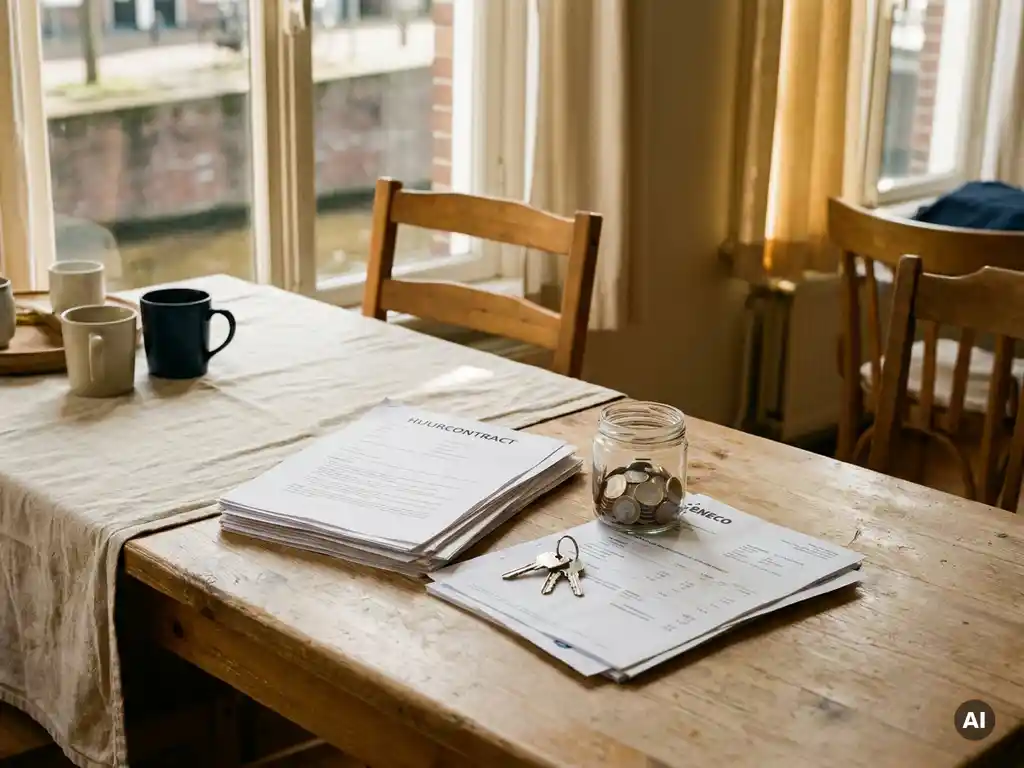
In addition to the base rent, you typically pay extra costs in the Netherlands such as service charges, municipal taxes, utilities, and contents insurance. For most tenants, these additional costs add up to €200 to €500 per month, depending on the property, the municipality, and your personal usage. As an expat, you may also face one-time costs such as a security deposit and agency fees. In this article, we answer the most frequently asked questions about what you can expect on top of your rent.
What are service charges and what do they cover?
Service charges are costs that a landlord charges on top of the base rent for services and facilities associated with the property. Think of maintenance of communal areas, a caretaker, the elevator, or sometimes also gas, water, and electricity. The rental agreement always specifies which service charges you pay and what they cover.
Service charges can be settled in two ways: as a fixed monthly amount or as an advance payment with annual settlement. With an advance payment, you pay an estimated amount each month, after which the landlord calculates the actual costs at the end of the year. If consumption is lower, you receive a refund. If it is higher, you pay the difference.
Legally, a landlord may only pass on service charges for services that are actually provided. As a tenant, you have the right to request an itemized statement of what is included in the service charges. Not sure whether the costs are reasonable? The Rent Tribunal (Huurcommissie) can issue a ruling on this.
Common examples of service charges include:
- Cleaning of communal areas
- Maintenance of the elevator or garden
- Heating costs for central heating
- Internet connection (in some complexes)
- Caretaker costs
Need a local Homie?
Share your plans with us and discover how we can help with your home, move or relocation in the Netherlands.
How much in municipal taxes do you pay as a tenant?
As a tenant in the Netherlands, you pay a number of municipal taxes, of which the waste disposal levy and the sewage charge are the most common. The amount varies per municipality, but on average you should expect €300 to €500 per year for a single-person household, and slightly more for multi-person households.
In Amsterdam, tenants do not pay property tax (OZB). This is a tax that applies only to property owners. You will, however, receive an annual assessment from the Municipal Tax Office for the waste disposal levy and sewage charge. You pay this amount directly to the municipality, not to the landlord.
Do you have a low income? In many municipalities, you can apply for a waiver of municipal taxes. This also applies to expats who meet the income requirements and are registered with the municipality.
What does contents insurance cost in the Netherlands?
Contents insurance covers damage to your personal belongings in the home, such as furniture, electronics, and clothing. In the Netherlands, a standard contents insurance policy costs on average €5 to €15 per month, depending on the value of your contents, the location of the property, and the level of coverage chosen.
Contents insurance is not mandatory, but it is strongly recommended. Especially in a city like Amsterdam, where residential burglary is more common than in smaller cities, the protection is worth the relatively low monthly premium. When taking out a policy, pay attention to the difference between new-for-old coverage (compensation based on purchase value) and actual cash value coverage (compensation based on current value after depreciation).
As an expat, it is important to know that you can also take out temporary insurance, for example for the duration of your rental contract. Some insurers offer specific packages for people living in the Netherlands on a temporary basis.
What one-time costs are involved when moving into a rental property?
When moving into a rental property in the Netherlands, in addition to the first month’s rent you typically pay a security deposit of one to three months’ rent. This is a one-time payment that you get back when you leave the property in good condition.
Other one-time costs you can expect include:
- Agency fees: Some landlords or agencies charge fees for their mediation services, although this has been legally restricted for property seekers.
- Utility connection fees: When setting up new contracts for gas, water, and electricity, one-time connection or administration fees may apply.
- Municipal registration: Registration with the municipality (BRP) is free, but you should make sure to arrange this immediately upon arrival.
- First month’s rent + deposit at once: Be prepared to transfer two to four months’ rent at the time of signing the contract.
Make sure you budget for these costs in advance, as they can add up to a significant amount, especially if you are also incurring moving costs at the same time.
How high are utility costs in an average rental property?
The monthly utility costs in an average Dutch rental property for a single-person household are around €100 to €200 per month for gas, water, and electricity combined. For families or in poorly insulated properties, these costs can be higher.
The exact amount depends on several factors:
- Energy label of the property: A property with label A or B consumes considerably less than a property with label E or F.
- Type of heating: District heating (heat network) works differently from a gas-fired central heating boiler and has its own rate structure.
- Water consumption: Water prices vary by region, but on average a single person pays around €20 to €30 per month.
- Energy prices: These fluctuate. In 2026, energy prices are more stable than in the peak years before, but it is still worthwhile to compare suppliers.
Always ask during a viewing about the energy label and the average energy costs of the property. This gives you a realistic picture of what you will spend each month.
What additional costs do you pay as an expat renting in the Netherlands?
As an expat moving to the Netherlands, you may encounter higher or additional costs that are less common for local tenants. Think of higher security deposits (landlords sometimes require more security if you have no Dutch employment history), costs for temporary accommodation while you search, and expenses related to the immigration process.
Specific cost items for expats include:
- Temporary housing: If you have not yet found a permanent home, you pay for a serviced apartment or short-stay accommodation, which is more expensive than regular rent.
- IND fees: For non-EU expats, there are fees associated with applying for a residence permit. These costs vary depending on the type of permit.
- Translation costs or legal advice: Rental contracts are in Dutch. If you do not speak the language, it is wise to have a contract reviewed before you sign.
- Purchasing household contents: Many expats rent a furnished property, but if the property is unfurnished, you need to account for the costs of furniture and household appliances.
In addition, it is good to know that as an expat you may be entitled to the 30% ruling, a tax scheme under which part of your salary is paid out tax-free. This can significantly increase your net income and thereby partly offset the additional costs of expat housing.
How we help with the costs of renting in the Netherlands
At Urban Homies, we understand that the additional costs of renting in the Netherlands come as a surprise to many expats. That is why we guide you not only in finding a suitable property, but also with everything that comes after. We review rental contracts for hidden cost items, negotiate terms on your behalf, and help you set up utilities. That way, you know exactly where you stand, even before you have the keys in hand.
Our expat housing services also include support with municipal registration, BSN application, and for non-EU expats the IND procedure. We work together with tax specialists and legal partners who can advise you on the 30% ruling and other tax benefits. Want to know what your move to the Netherlands will actually cost? Contact us for a personal consultation.
Need a local Homie?
Share your plans with us and discover how we can help with your home, move or relocation in the Netherlands.