
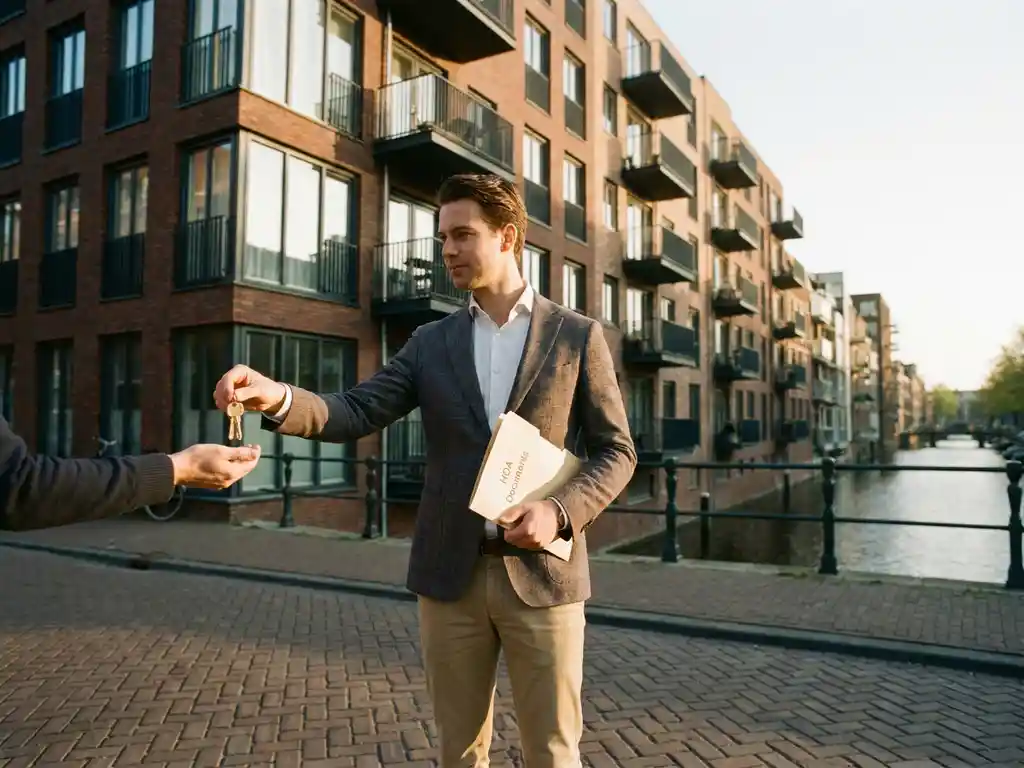
Selling an apartment within a Homeowners Association (HOA) involves extra steps that you won’t encounter when selling a standalone property. The HOA affects the documentation, the price, and sometimes even the sales process itself. In this article, we answer the most frequently asked questions about selling an HOA apartment, so you can go into the process fully prepared.
What are the obligations of an HOA when selling?
When selling an apartment within an HOA, you as the seller are required to fully inform the buyer about the financial and legal situation of the association. This means making relevant HOA documents available, informing the buyer about ongoing obligations, and not concealing any debts or disputes.
The HOA itself also has a disclosure obligation to the notary. At the time of ownership transfer, the HOA provides a so-called HOA declaration, which states whether there are any arrears on monthly contributions and whether any special decisions have been made that affect the new owner — such as planned renovations or increases in service charges.
As the seller, you are responsible for providing all necessary information. Failing to do so puts you at risk of the buyer filing claims after the fact for non-disclosure. Transparency here is not a choice — it is an obligation.
What documents does a buyer request from an HOA?
When purchasing an HOA apartment, a buyer requests a standard set of documents to assess the health of the association. The most important items are the deed of division, the house rules, the most recent financial statements, the budget, and the minutes of the last general meeting.
In addition, a thorough buyer will always ask for the long-term maintenance plan (LTMP). This plan outlines what maintenance is scheduled for the coming years and whether the reserve fund is sufficiently funded to cover it. A missing or outdated LTMP is a warning sign.
The most commonly requested documents at a glance:
- Deed of division and division drawings
- HOA house rules
- Financial statements and budget for the current year
- Minutes of the last general members’ meeting (GMM)
- Long-term maintenance plan (LTMP)
- HOA declaration including reserve fund balance and any arrears
- Proof of HOA registration with the Chamber of Commerce
As a seller, it is best to make these documents available early in the sales process. This speeds up the buyer’s due diligence and prevents delays when signing the purchase agreement.
How does the reserve fund affect the sale price?
A well-funded reserve fund has a positive effect on the sale price of an apartment, while an empty or underfunded reserve discourages buyers or leads to lower offers. The reserve fund gives buyers confidence that future maintenance can be paid for without requiring additional contributions.
When the reserve fund is low, buyers know that after purchase they may face a one-time special assessment or a structural increase in monthly service charges. They often factor that risk into their offer.
Conversely, an apartment in an HOA with a solid reserve fund and an up-to-date LTMP projects financial health. This builds buyer confidence and strengthens your negotiating position as a seller. A well-funded reserve fund is therefore a selling point you can actively leverage.
Keep in mind that the reserve fund balance is not automatically transferred to the buyer upon handover. The fund remains the property of the HOA. What the buyer does acquire is the right to a share of that fund, based on their proportional share as defined in the deed of division.
Does an HOA need to approve the sale?
In most cases, an HOA does not need to approve the sale of an individual apartment. The right to sell your property is a fundamental ownership right that the HOA cannot block. However, the deed of division may contain specific provisions that affect the transfer.
Some deeds of division include an approval requirement or right of first refusal. An approval requirement means the HOA must approve the new owner before the transfer can take place. A right of first refusal means you must first offer the apartment to the other owners before putting it on the market.
These provisions are not common, but it is important to read the deed of division carefully before selling. If necessary, have it reviewed by a notary or legal advisor. If the deed contains no special provisions, nothing stands in the way of a standard sale.
What happens to the HOA contribution after the transfer?
After the ownership transfer, the obligation to pay the monthly HOA contribution automatically passes to the new owner. From the day of the notarial transfer, the buyer is responsible for the service charges. Any arrears on the seller’s part remain, in principle, the seller’s responsibility.
The notary settles the HOA contribution at the time of transfer on a pro-rata daily basis. If you as the seller have already paid the contribution for the entire month and the transfer takes place mid-month, you will receive the remaining portion back through the notarial settlement.
Important: make sure there are no outstanding arrears on the HOA contribution at the time of sale. Arrears can delay or complicate the transfer, as the HOA is required to issue a declaration regarding this to the notary.
What role does a real estate agent play in selling an HOA apartment?
A real estate agent plays an active role in selling an HOA apartment by not only presenting the property, but also gathering, reviewing, and clearly explaining the HOA documentation to potential buyers. This goes further than with a standard property sale, because the financial health of the HOA directly affects the appeal of the apartment.
An experienced agent helps you with:
- Requesting and reviewing all relevant HOA documents
- Determining a realistic asking price based on the reserve fund and the LTMP
- Communicating HOA information transparently to interested buyers
- Guiding negotiations in which HOA-related factors play a role
- Coordinating with the notary regarding the HOA declaration and the transfer
Buyers ask targeted questions about the HOA as soon as they show serious interest. An agent who can answer these questions quickly and thoroughly builds trust and shortens the sales process.
How we help you sell your HOA apartment
Urban Homies guides you from start to finish in selling your apartment, including everything that comes with an HOA. We carry out a property valuation, arrange professional photography, and develop a targeted marketing strategy. We also help you gather all the HOA documents and ensure that potential buyers are well informed about the financial situation of the association.
What you can expect from us:
- Property valuation based on current market conditions and the HOA situation
- Documentation gathering and review, including the deed of division and LTMP
- Professional presentation with photography and a tailored listing
- Guidance through negotiations and coordination with the notary
- Aftercare following the transfer
Want to know what your apartment is worth and how we approach the sale? View our sales guidance services or get in touch directly for a no-obligation consultation.