
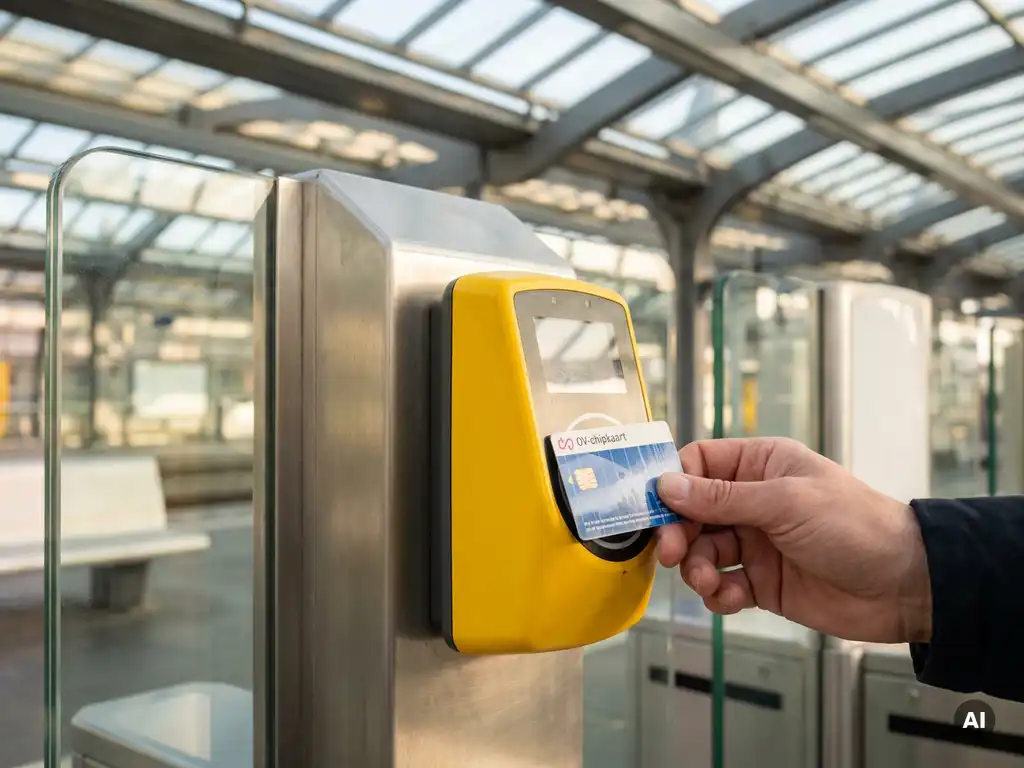
In the Netherlands, you pay for public transport with an OV-chipkaart, your personal bank card (via OV-pay), or a digital subscription through a transport app. The OV-chipkaart is still the most widely used method, but contactless payment with your bank card is quickly gaining ground. In this article, we answer the most frequently asked questions about paying for Dutch public transport, so you as an expat can get started right away.
What payment methods are available for public transport in the Netherlands?
In Dutch public transport, you can pay with an OV-chipkaart, a bank card or credit card via OV-pay, or a digital subscription through a transport provider’s app. You always check in and out at a yellow or orange reader at the station or on the vehicle, regardless of which payment method you use.
The three common options at a glance:
- OV-chipkaart: a physical chip card that you top up with credit or load a subscription onto
- OV-pay (contactless payment): check in with your bank card, credit card, or phone via NFC
- Digital subscriptions: such as the NS annual card or a regional transport subscription, managed via an app or personal OV-chipkaart
Which method is most convenient depends on how often you travel and with which transport providers. Travelers who take the train daily often benefit from a subscription. Those who travel occasionally are more likely to opt for credit on the OV-chipkaart or OV-pay.
Need a local Homie?
Share your plans with us and discover how we can help with your home, move or relocation in the Netherlands.
How does the OV-chipkaart work in the Netherlands?
The OV-chipkaart is a rechargeable chip card that you use to check in when boarding and check out when leaving a bus, tram, metro, or train. The system automatically calculates the travel costs based on the distance traveled and deducts them from the balance on your card.
There are two types of OV-chipkaarts:
- Personal OV-chipkaart: linked to your name and address. Registered to you, so if lost, you can have the balance restored. You can also load subscriptions onto it.
- Anonymous OV-chipkaart: not registered to a name, similar to a prepaid card. Handy as a temporary solution, but if lost, you lose the balance.
For every journey, you need to have sufficient credit on the card. For the train, a minimum boarding threshold applies: you need at least a certain amount to be able to check in. If you forget to check out, the system charges a high fare for a standard travel distance. So always make sure you check in when you depart and check out at the yellow reader when you arrive.
Can I travel with my bank card on Dutch public transport?
Yes, in an increasing number of Dutch cities and on the NS train network, you can pay directly with your bank card, credit card, or smartphone via OV-pay. You hold your card or phone against the reader when boarding and alighting, just like with the OV-chipkaart. The amount is automatically debited from your account afterwards.
OV-pay works in 2026 with NS, the Amsterdam metro, and multiple bus and tram lines. Not all transport providers fully support the system yet, so check in advance whether your route is compatible. On the website of the relevant transport provider or via the NS app, you can immediately see whether OV-pay is available on your route.
A practical advantage of OV-pay is that you don’t need to purchase or top up a separate card. For expats who have just arrived in the Netherlands and are moving to Amsterdam or another city, this is an accessible way to start traveling immediately.
What is cheaper: a public transport subscription or paying for individual journeys?
A public transport subscription is cheaper than individual journeys once you travel regularly and on fixed routes. Those who take the train daily pay significantly less per journey with an NS subscription than with loose credit. Travelers who only travel a few times a week or take irregular routes often pay less per journey without a subscription.
Some popular subscription types:
- NS Flex: no fixed costs, but a discount on train journeys depending on the chosen discount level (such as 40% or 100% off-peak)
- NS Annual Card: unlimited travel throughout the Netherlands, suitable for daily commuters
- City subscription: unlimited travel within a specific city or region, offered by local transport providers
Calculate for yourself how much you would spend on individual journeys per month and compare that with the subscription costs. Many transport providers offer online calculation tools. Also take into account the costs of moving to the Netherlands: a subscription only makes sense once you know how long you are staying and which routes you will regularly use.
How do I buy or top up an OV-chipkaart as an expat?
You can buy an OV-chipkaart at an NS service point at a train station, at supermarkets such as Albert Heijn, or online via ov-chipkaart.nl. An anonymous card is immediately available; for a personal card, you fill in an application form online and receive the card by post.
You can top up your credit in several ways:
- Top-up machines at stations and in the metro
- Service points at NS or local transport providers
- Online via ov-chipkaart.nl (for personal cards; credit is loaded at the next check-in)
- Supermarkets that offer OV-chipkaart top-up points
As an expat just arriving in the Netherlands, an anonymous OV-chipkaart is the fastest option to start traveling immediately. Once you have a Dutch bank account number, a personal card or OV-pay is the most convenient choice for the longer term. Keep in mind that applying for a personal card can take a few working days.
How we help you get started in the Netherlands
Practical matters such as public transport are just a small part of everything involved in moving to the Netherlands. At Urban Homies, we guide you from start to finish: from finding a home and arranging your BSN number to municipal registration and setting up your utilities. You are paired with a personal homie who knows the local market and guides you through every step, so you can focus on your new job and life.
Whether you are moving to Amsterdam for the first time as an expat or you are an HR manager looking to help an employee settle in, we ensure a smooth arrival. That also means we help you find your way with practical matters like public transport, so you are immediately mobile in your new city. Want to know what we can do for you? Check out our expat housing services or contact us directly for a personal conversation.
Need a local Homie?
Share your plans with us and discover how we can help with your home, move or relocation in the Netherlands.