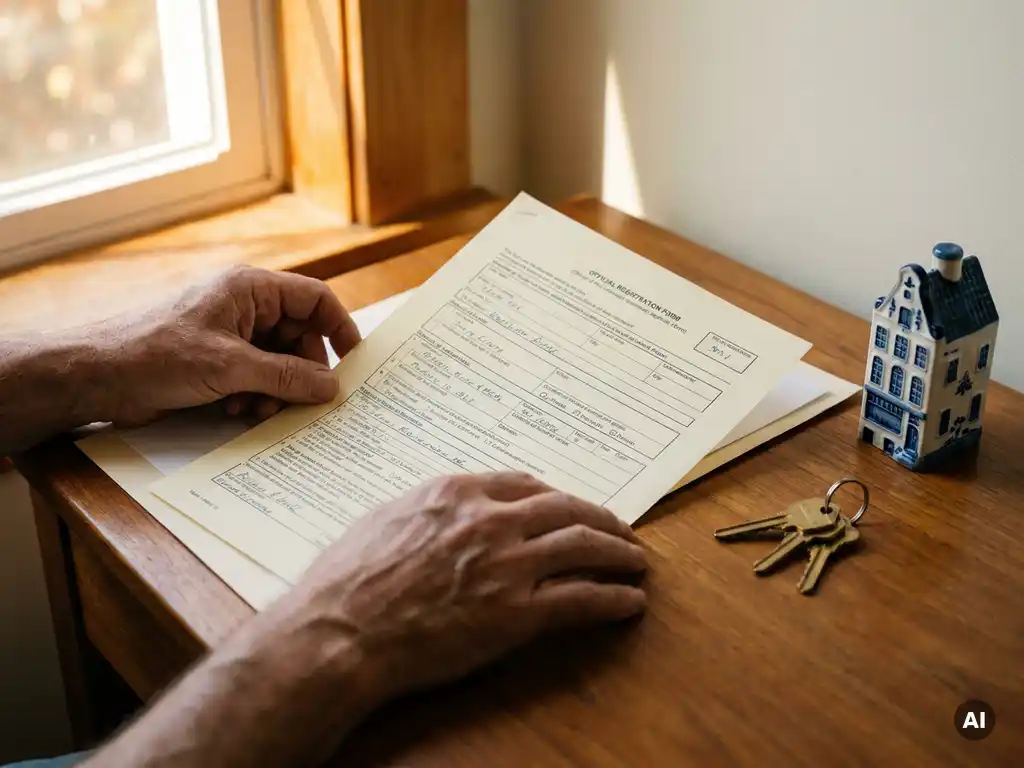
You register with a Dutch municipality by making an appointment at the town hall and presenting yourself in person with the required documents. Once you are registered in the Personal Records Database (BRP), you will automatically receive a Citizen Service Number (BSN). You need this number for almost everything in the Netherlands: from opening a bank account to taking out health insurance. In this article, we answer the most frequently asked questions about the registration procedure, so you know exactly what to expect.
What documents do you need for registration?
To register with the municipality, you need a valid identity document and proof of residence. The exact documents required depend on your nationality and living situation, but the basic requirements are the same in most Dutch municipalities.
These are the documents you typically bring to the appointment:
- Identity document: a valid passport or, for EU citizens, a national identity card
- Proof of residence: a rental contract, a declaration from the landlord or owner, or a deed of purchase
- Birth certificate: sometimes required, depending on your municipality and nationality
- Marriage certificate or cohabitation agreement: if you are bringing a partner who also needs to be registered
- Proof of residence status: for non-EU citizens, this is a valid visa or residence permit
Non-EU citizens should be aware that the municipality may in some cases request additional documents that must first be legalized or provided with an apostille. Check this in advance with your specific municipality, as requirements can vary slightly between municipalities. Amsterdam, Amstelveen, and other major cities generally have extensive information about this on their municipal websites.
How does the appointment at the municipality work?
You make an appointment through the website of the municipality where you are going to live. On the agreed date, you present yourself in person at the municipal desk, submit the required documents, and the staff member enters your details into the Personal Records Database (BRP). The appointment itself usually takes between ten and twenty minutes.
Most municipalities offer the option to book an appointment online. In busier cities such as Amsterdam, waiting times for available appointments can run to several weeks, so it pays to arrange this as soon as possible after arrival. Some municipalities also offer an urgent procedure, for example if you urgently need a BSN for work or health insurance.
Please note: you must register with the municipality of the city or town where you actually live, not with an arbitrary municipality of your choice. If you live in Amstelveen, you register with the municipality of Amstelveen, even if you work in Amsterdam.
What is the difference between a temporary and permanent registration?
A permanent registration applies if you are staying in the Netherlands for longer than four months and have a fixed home address. A temporary registration, also known as an RNI registration (Registration of Non-Residents), is intended for people who are in the Netherlands for less than four months or do not have a fixed address.
With an RNI registration, you do receive a BSN, but you are not included in the BRP of a specific municipality. This type of registration is available at one of the ten designated RNI desks in the Netherlands, spread across major cities. It is a useful option if you have not yet found permanent housing but are already starting work or want to open a bank account.
Once you have moved into a permanent home and are staying in the Netherlands for longer than four months, you are required to register with the municipality of your place of residence. The temporary RNI registration therefore does not replace regular municipal registration in the long term.
How long does it take to receive your BSN?
With a regular municipal registration, you receive your BSN directly during or shortly after the appointment. In most cases, the number is already in the systems of relevant authorities, such as the Tax Authority and health insurers, within a few working days.
With an RNI registration, the process is slightly different: your BSN is generally assigned within five working days after the appointment and communicated to you by post or digitally. It is wise to keep your BSN safe, as you need it for virtually every administrative action in the Netherlands.
Please bear in mind that the BSN itself becomes available quickly, but that linking this number to external systems can sometimes take a little longer. Your health insurer or employer may in the meantime ask for proof of registration, which the municipality can provide to you as a confirmation letter.
Do you need to re-register when you move within the Netherlands?
Yes, if you move to a different home within the Netherlands, you are legally required to notify the municipality of your new address. You must do this within five days of moving. Your BSN remains the same, but your address details in the BRP are updated.
If you move within the same municipality, you notify them of the address change via that municipality’s website, often without needing to make an appointment. If you move to a different municipality, you deregister from the current municipality and register with the new one. In practice, the new municipality often arranges this automatically once you register there.
Also remember to notify the Tax Authority, your health insurer, your bank, and other organizations that hold your address in their records of your new address. The BRP change is shared with a number of government authorities, but not automatically with all private parties.
How we help with municipal registration and BSN application
Municipal registration may sound like a simple step, but for expats who have just arrived in the Netherlands, it can be a stressful experience. Unfamiliar procedures, documents that need to be legalized, and waiting times for appointments: these are all things that can delay your settling in the Netherlands. We guide you through this entire process, from gathering the right documents to actually arranging the appointment and following up on the BSN application. For non-EU expats, we combine this with the IND procedure and the visa application process, so that everything runs in parallel and as quickly as possible.
As part of our expat housing services, you are assigned a personal homie who guides you step by step. We work with short lines of communication and set realistic expectations, so you know where you stand. Would you like to know how we can make your move to the Netherlands run smoothly? Contact us for a no-obligation conversation.