
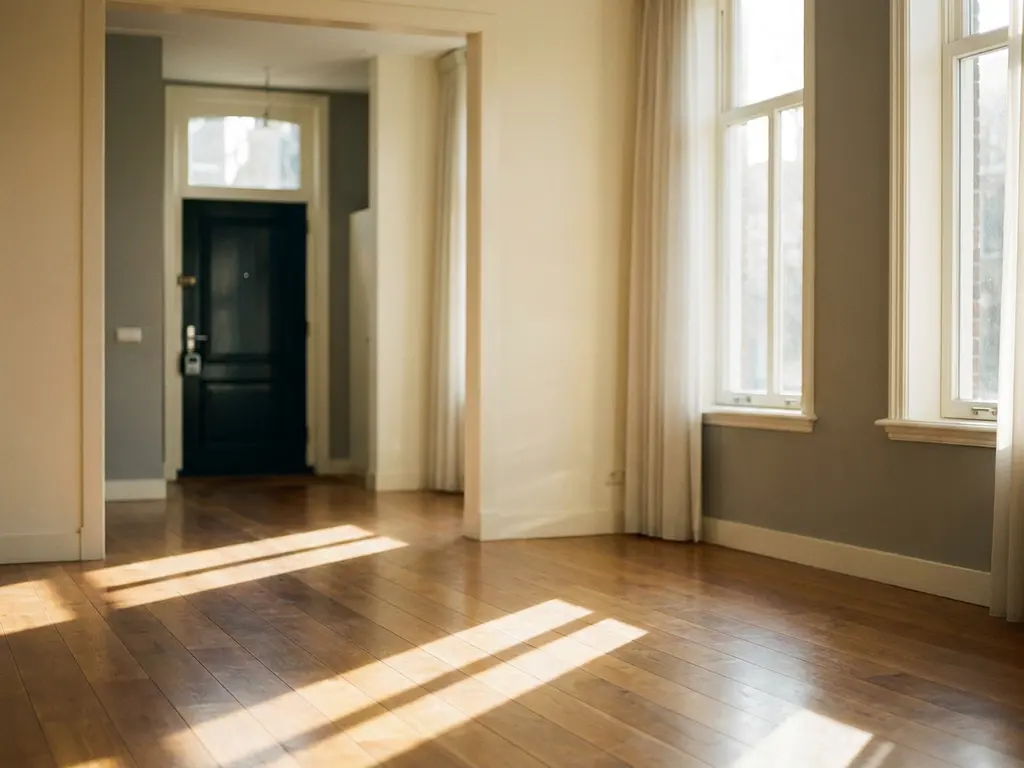
Selling a home empty isn’t necessarily smart or unwise. It depends on the condition of your property, your target audience, and the local market. In a competitive market like Amsterdam, empty homes sell just fine, but in a quieter segment, an empty space can put buyers off. In this article, we answer the most frequently asked questions about selling empty, so you can make an informed decision.
What are the advantages and disadvantages of selling empty?
Selling empty has clear advantages, but also a few drawbacks you shouldn’t underestimate. The biggest advantage is that buyers can assess the space with fresh eyes. At the same time, empty rooms lack atmosphere and a sense of scale, making it harder for some buyers to picture what the home would look like furnished.
Advantages of selling empty
- Buyers see the space honestly: no furniture hiding the layout or making a room look smaller than it actually is.
- No storage costs or hassle: you don’t need to move or store your belongings during viewings.
- Faster handover possible: you have flexibility on the transfer date, which is attractive to buyers who want to move quickly.
- Less emotional distraction: personal belongings can unintentionally draw buyers’ attention away from the home itself.
Disadvantages of selling empty
- Lack of atmosphere: empty rooms feel cold and it’s difficult to experience the home as a place to live.
- Proportions are harder to read: without furniture, buyers often can’t tell whether a room is large or small.
- Flaws stand out more: a scratch on the floor or a mark on the wall attracts more attention in an empty space.
- Photos are less inviting: empty rooms photograph less attractively, which affects the number of viewing requests.
Does an empty home sell for less than a furnished one?
Not automatically. The final sale price depends on many factors: location, condition, and supply and demand in the area. That said, experience shows that well-styled homes more often sell above the asking price, simply because they appeal to more buyers and viewings lead to offers more quickly.
An empty home that looks well-maintained, is situated in a desirable neighborhood, and is priced competitively will generally achieve a comparable price to a furnished one. But if your home is in a segment where buyers have plenty of choice, an empty presentation can mean it stays on the market longer. A longer selling period increases the likelihood that buyers will negotiate on price.
In short: selling empty doesn’t have to mean selling for less, but it does increase the risk of a longer time on the market if the presentation isn’t right.
What is home staging and does it help with an empty home?
Home staging is the professional styling of a property for sale, with the goal of helping buyers envision the space as their future home. For an empty property, this means placing rental furniture, accessories, and lighting to bring the rooms to life and make the layout easy to understand.
Home staging helps with empty homes because it solves two problems at once: the lack of atmosphere and the difficulty of reading proportions. A styled living room immediately shows how large a sofa can be, where a dining table fits, and how bright the space feels. This lowers the threshold for buyers to make an offer.
The cost of home staging varies, but is generally far lower than a first price reduction. What’s more, staged homes produce better photos, which directly affects the number of viewings on platforms such as Funda. If you have an empty home and are wondering whether to stage it, home staging is well worth serious consideration.
When is selling empty actually the smartest choice?
Selling empty makes sense if you’ve already moved out, if the property is in excellent condition, or if you’re selling in a market with limited supply. In those situations, the convenience of selling empty outweighs the potential drawbacks.
Specific situations where selling empty works well:
- Tight market: when demand exceeds supply, homes sell quickly regardless of how they’re furnished.
- New build or recently renovated: a home that looks fresh and well-maintained needs less styling to make an impression.
- Investors as your target audience: investors buy based on numbers and location, not atmosphere. An empty home is actually more transparent for them.
- You’ve already moved out: in that case, handing over the property empty is practical and avoids the cost of temporary storage or two separate moves.
Is your home dated, are the floors worn, or is the kitchen outdated? Then selling empty won’t help. In that case, investing in presentation or setting a sharp asking price is the more realistic approach.
How do you present an empty home as attractively as possible?
Presenting an empty home as attractively as possible requires attention to light, cleanliness, and a few strategic additions. The home doesn’t need to be fully furnished to make a good impression, but a completely bare space with no atmosphere rarely works in your favor.
Practical tips for a strong presentation:
- Maximize light: open all curtains and blinds, replace any broken bulbs, and use a high color temperature for a fresh, bright feel.
- Clean the home thoroughly: marks on walls, dirty windows, and grimy floors stand out even more in an empty space. Have the home professionally cleaned.
- Add small accents: a plant, a mirror, or a few accessories in the living room instantly add warmth without requiring a full styling job.
- Invest in professional photography: empty rooms are harder to photograph than furnished spaces. An experienced real estate photographer knows how to capture the space at its best.
- Consider virtual staging: through digital editing, furniture is added to photos. This is a cost-effective way to present the home more attractively online.
Do you have to hand over the home empty after the sale?
Yes, in most cases you are required to hand over the home empty after the sale, unless you have made other arrangements in writing in the purchase agreement. The standard NVM purchase contract assumes that the property will be transferred free of occupation and fully vacated on the agreed date.
Do you want to take certain furniture or appliances that the buyer expects to be included? Make sure to specify this explicitly in the purchase agreement. Think of freestanding light fixtures, curtains, a dishwasher, or garden furniture. Anything not listed on the movable property schedule and not excluded is assumed to be part of the home.
The same applies in reverse: if you want to leave something behind that the buyer doesn’t want, you are obligated to remove it. Leaving junk in the shed or basement can lead to a dispute and liability for the removal costs. Always ensure you have a clear and complete movable property schedule as part of the sales process.
How we help you sell your home
At Urban Homies, we guide you through the entire sales process, from the initial valuation to signing at the notary. We develop a targeted marketing strategy, arrange professional photography, and write a listing that positions your home correctly in the market. Whether you’re selling empty or furnished, we work with you to find the best approach for your specific situation.
What we do for you:
- Valuation and market analysis based on current data in your area
- Advice on presentation, including whether home staging makes sense for your property
- Professional photography and a tailor-made listing
- Support during negotiations and legal handling
- Personal guidance right through to the transfer at the notary
Want to know what your home is worth and how best to approach the sale? Get in touch and we’ll schedule a no-obligation consultation. Or take a look at our sales guidance service for more information on how we work.