
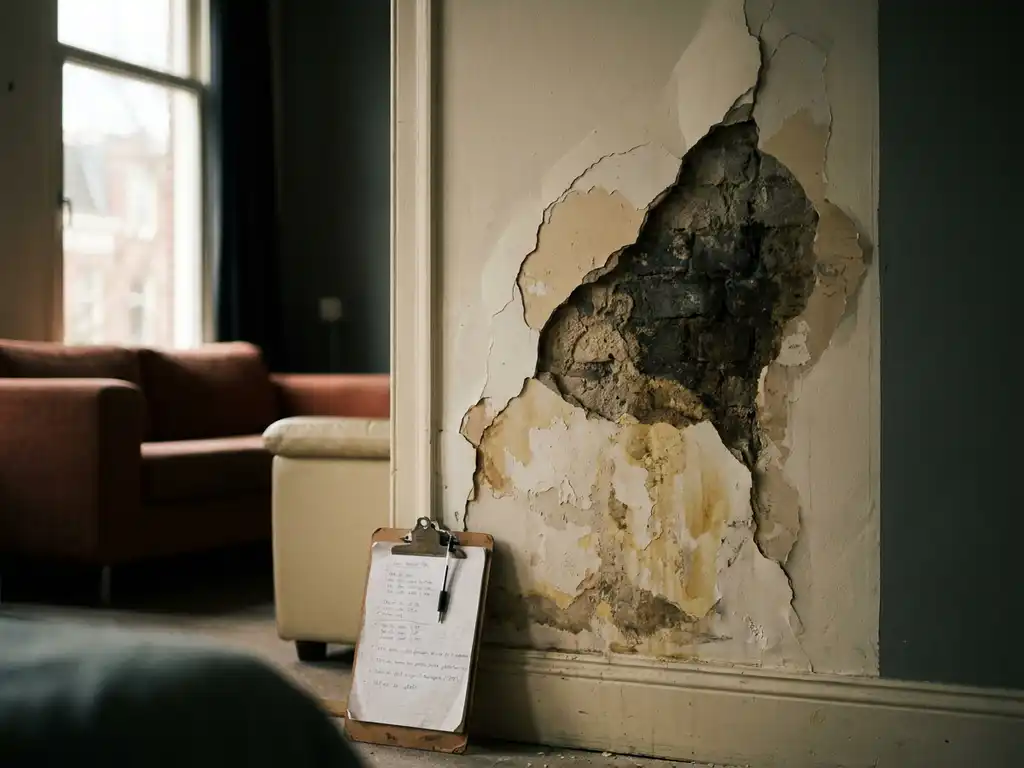
A hidden defect is a fault or flaw in a property that was not visible at the time of purchase and that the buyer could not reasonably have discovered during a standard viewing. In the Netherlands, the seller is generally liable for hidden defects, unless an age clause or other contractual limitation applies. The questions below give you a clear picture of your rights and options as a buyer.
Who is liable for a hidden defect?
In the case of a hidden defect, the seller is liable, because under Article 7:17 of the Dutch Civil Code, the seller is required to deliver a property that conforms to the agreement. If a defect prevents normal habitation and the buyer was not aware of it and could not reasonably have been expected to anticipate it, the seller can be held responsible for repairs or compensation.
However, the seller’s liability is not unlimited. Two factors play a significant role:
- Age clause: With older properties, sellers frequently include an age clause in the purchase agreement. By accepting this clause, you as the buyer acknowledge that the property is older and that defects related to its age are your responsibility.
- Asbestos clause or “non-owner-occupancy clause”: Similar limitations are sometimes included when the seller has never lived in the property themselves and therefore has limited knowledge of its condition.
As a buyer, you also have your own duty to investigate. You may rely on statements made by the seller, but you are personally responsible for carrying out a reasonable inspection. If a defect would have been visible during a standard viewing, it generally does not fall under the category of hidden defects.
What are examples of hidden defects in a property?
Hidden defects are flaws that are not visible during a standard viewing and only come to light after the purchase. Common examples include moisture problems behind wall paneling, foundation damage, concealed leaks, asbestos in floors or ceilings, and faulty electrical installations that do not meet safety standards.
Other defects that frequently emerge after purchase include:
- Wood rot behind exterior cladding or window frames
- Floor subsidence caused by a deteriorating foundation
- Mold in cavity walls or beneath floors
- Leaking roof structures that go unnoticed in dry weather
- Sewer problems or blocked drainage pipes
- Unlicensed extensions or renovations
Not every defect automatically qualifies as a hidden defect. A loose tile or a creaking door are visible flaws that a buyer could have identified themselves. Hidden defects specifically refer to flaws that substantially prevent normal habitation and that could not reasonably have been anticipated at the time of purchase.
How do you prove that a hidden defect exists?
To prove a hidden defect, you must demonstrate that the defect was already present at the time of transfer, that it was not visible during the viewing, and that it prevents normal habitation. In practice, this requires an independent expert report from a structural advisor or a certified inspector.
In concrete terms, you can take the following steps:
- Document the defect immediately: Take photos and videos as soon as you discover the defect. Also note the date of discovery.
- Bring in a structural expert: An independent specialist will prepare a report on the nature, severity, and probable age of the defect.
- Formally notify the seller in writing: Send a registered letter or email with a clear description of the defect and the remedy you are requesting.
- Keep all correspondence: Emails, messages, and letters exchanged with the seller, real estate agent, or notary are valuable evidence.
The expert report is the most powerful piece of evidence. It not only describes what is wrong, but also establishes whether the defect could reasonably have been present at the time of purchase. Without such a report, it is difficult to pursue a legal claim successfully.
How long after purchase can you claim a hidden defect?
You must report a hidden defect as soon as possible after discovering it. By law, there is a complaint period of two months from the date of discovery. After this period, your right to hold the seller liable lapses. The general statute of limitations for claims based on non-conformity is two years from the date of notification, although in exceptional cases this can extend to five years.
Two deadlines are therefore relevant:
- Complaint period: Two months from discovery to notify the seller in writing. If you wait longer, you will in principle lose your right to make a claim.
- Statute of limitations: Two years from the date of notification to actually initiate legal proceedings, unless the limitation period is interrupted.
In practical terms, this means: if you discover a leaking roof structure six months after purchase, report it to the seller in writing within two months. Do not wait until you know the full extent of the damage. An early notification protects your legal position, even if the total amount of damages has not yet been established.
What can you do if the seller refuses to cooperate?
If the seller denies the existence of a hidden defect or refuses to cooperate on repairs, you have several options. You can engage a mediator as a first step, initiate court proceedings, or in certain cases file a complaint with a professional association if the seller worked through a real estate agent. In all cases, a strong file of documentation is essential.
The most common steps are:
- Registered notice of default: Give the seller a reasonable period of time to repair the defect or provide compensation.
- Mediation: A neutral mediator can help both parties reach a resolution without going to court. This is faster and less costly.
- Court proceedings: If mediation fails, you can initiate civil proceedings. The court will then assess whether the defect was hidden and who is liable.
- Complaint to the NVM or VBO: If the seller worked through a certified real estate agent, you can file a complaint with the relevant professional association.
In the event of a serious dispute, always consult a legal advisor who specializes in property law. Legal proceedings can be costly, but when the damage is significant, going to court is often the only way to recover your money.
Does a structural survey protect against hidden defects?
A structural survey offers no complete protection against hidden defects, but it does significantly reduce the risk. The survey identifies visible and technical defects that an ordinary buyer might miss, but it cannot always detect flaws concealed behind walls, beneath floors, or within foundations.
What a structural survey does do:
- It provides an objective assessment of the property’s technical condition.
- It identifies risks such as moisture problems, roof leaks, and outdated installations.
- It gives you a stronger negotiating position on the purchase price.
- It strengthens your evidentiary position if it later emerges that a defect was already present.
What a structural survey cannot do:
- Detect defects behind sealed walls or beneath finished floors.
- Provide legal protection if you have signed an age clause.
- Guarantee that all hidden defects have been identified.
Having a survey carried out before purchase is a wise decision, particularly for older properties. The report not only gives you insight into the condition of the property, but can also serve as a basis for negotiating the price or supporting a future claim.
How we help you sell your property
When selling a property, you want to avoid disputes arising afterward about defects you were unaware of. Urban Homies guides you as your selling agent through the entire process, from valuation and due diligence to signing at the notary. We help you communicate transparently about the condition of the property, so that you as the seller are well protected.
What we do for you:
- A thorough valuation and market analysis of your property
- Advice on correctly documenting the condition of the property
- Professional photography and a tailored listing
- Support during negotiations and contract preparation
- Collaboration with notaries and legal advisors for a watertight sales process
Would you like to sell your property without any surprises afterward? Contact us and we will discuss together how to handle your sale carefully and effectively.