
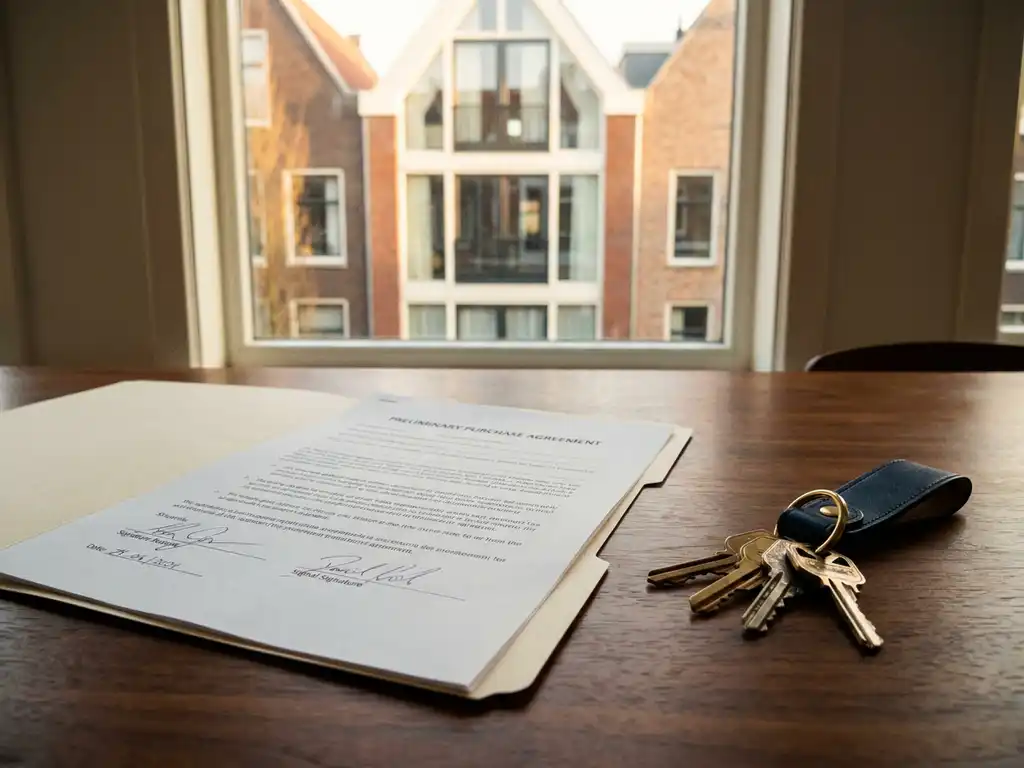
A preliminary purchase agreement is the written contract that buyer and seller sign after reaching verbal agreement on the sale of a property. The contract records all arrangements: the purchase price, the transfer date, and any contingency clauses. Despite the word “preliminary,” this contract is legally binding on both parties. In this article, we answer the most frequently asked questions about the preliminary purchase agreement, so you are well prepared when selling a property.
What does a preliminary purchase agreement contain?
A preliminary purchase agreement contains all the arrangements between buyer and seller needed to facilitate the transfer of the property. The document describes who the parties are, what is being sold, for what amount, and under what conditions. This contract forms the legal basis for the final transfer at the notary’s office.
The standard content of a preliminary purchase agreement typically includes the following elements:
- Personal details of the buyer and seller
- Description of the property, including address and cadastral details
- The agreed purchase price
- The transfer date, i.e., when the keys will be handed over
- Contingency clauses, such as a financing condition
- The deposit or bank guarantee the buyer must provide (typically 10% of the purchase price)
- Agreements regarding movable items, such as which furniture or appliances will remain
It is advisable to also document any agreements about the condition of the property and any known defects in writing. This helps avoid disputes later on. When it comes to the sale of a property, an experienced party can help ensure nothing is overlooked.
When does a preliminary purchase agreement become final?
The preliminary purchase agreement becomes final once the buyer’s cooling-off period has expired and all contingency clauses have lapsed or been withdrawn. By law, the buyer has three days after signing to cancel the contract without giving a reason. After that, both parties are fully bound by the agreed terms.
The cooling-off period applies only to the buyer, not the seller. This is a statutory right that provides protection for such a significant purchase. Once the cooling-off period and any contingency clauses have expired, the contract is irrevocable, unless both parties jointly decide to amend or dissolve it.
The final transfer then takes place at the notary’s office. At that point, ownership is officially transferred and the preliminary purchase agreement is converted into a notarial deed.
What are contingency clauses and how do they work?
Contingency clauses are provisions in the purchase agreement that allow the buyer or seller to cancel the contract if a specific situation arises, without incurring a penalty. They provide a safety net for unforeseen circumstances. The most commonly used contingency clause is the financing condition.
Other common contingency clauses include:
- Financing condition: the buyer can cancel the contract if the mortgage is not approved
- Structural survey: if the property has serious defects that exceed an agreed cost threshold
- National Mortgage Guarantee (NHG): the purchase only proceeds if the buyer qualifies for NHG
- Permits: when purchasing for renovation or commercial use
If a contingency clause is invoked, this must be done within the agreed timeframe and communicated in writing. The buyer must also demonstrate that the clause genuinely applies, for example by providing a rejection letter from the lender.
What happens if you fail to fulfill the purchase agreement?
If the buyer or seller fails to fulfill the preliminary purchase agreement, the other party is entitled to a penalty of 10% of the purchase price. This is the standard deposit that the buyer pays upon signing or for which a bank guarantee is provided. In addition to the penalty, the aggrieved party may also seek specific performance or claim damages through the courts.
It is important for sellers to understand that they are equally bound by the contract. If a seller proceeds to sell the property to someone else or refuses to complete the transfer, the buyer can demand performance or claim damages that may exceed the 10% penalty.
Breaching a contract therefore carries serious financial consequences. It is wise to sign only when you are certain of your position, and to ensure that contingency clauses are carefully worded so that you have a way out if circumstances change.
Does a real estate agent or notary need to draw up the contract?
A real estate agent or notary is not legally required to draw up the preliminary purchase agreement, but it is strongly recommended. In practice, the selling agent or notary prepares the contract, as they have the necessary knowledge of legal requirements and standard clauses in the property market.
Drawing up a contract yourself is technically possible, but carries risks. Missing or incorrectly worded clauses can lead to disputes or financial loss down the line. A notary is required for the final transfer: the transfer of ownership must always be completed through a notarial deed.
In practice, the roles are divided as follows:
- The real estate agent draws up the preliminary purchase agreement and guides the negotiations
- The notary reviews the contract and handles the legal transfer
- The buyer and seller sign both documents
How we help you sell your property
At Urban Homies, we guide you from start to finish through the process of selling your property. We begin with a thorough valuation and a clear marketing strategy, ensuring your property is presented to the market in the best possible way. This includes professional photography, a tailored listing, and active support throughout viewings and negotiations.
What we take care of for you:
- Valuation and market analysis
- Professional presentation of your property
- Support during negotiations and contract preparation
- Collaboration with notaries for a smooth transfer
- Aftercare following the transfer
Would you like to know what your property is worth or how we approach the sales process? Get in touch with us and we will be happy to tell you more.