
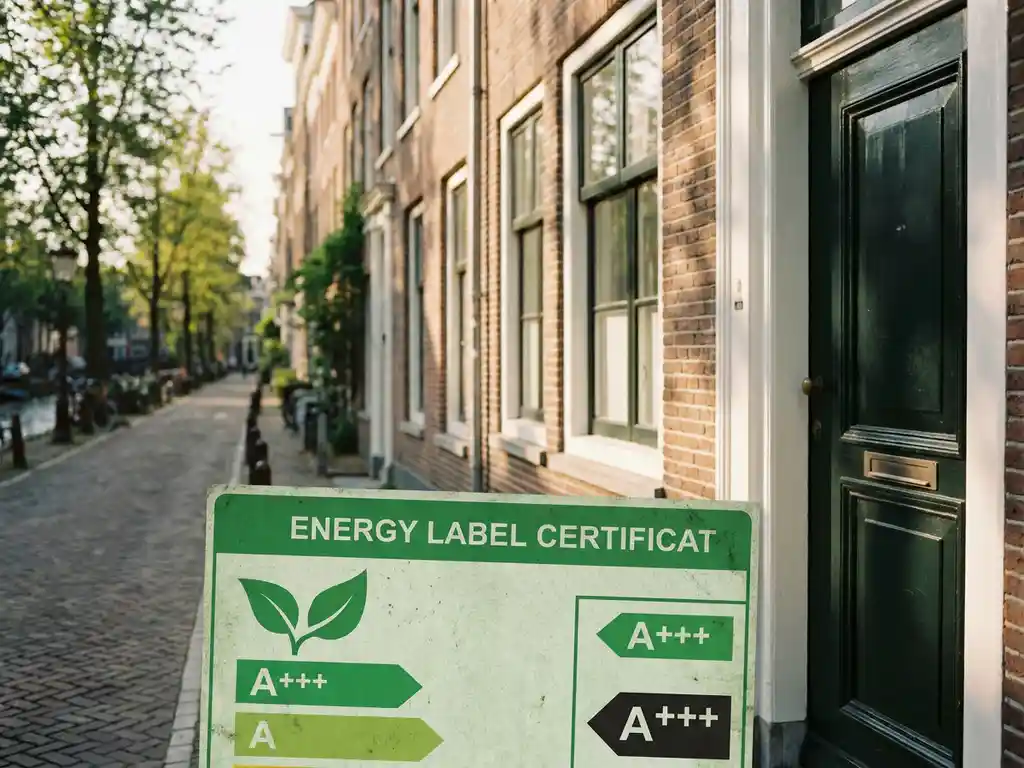
Yes, an energy label is mandatory when selling a home in the Netherlands. As a seller, you are legally required to provide a valid energy label to the buyer at the time of transfer. Failure to do so puts you at risk of a fine from the Dutch government. In this article, we answer the most frequently asked questions about energy labels when selling a home.
When is an energy label required when selling a home?
An energy label is required from the moment you list your home for sale and no later than at the transfer with the notary. The requirement applies to virtually all homes in the Netherlands, including detached houses, apartments, and terraced houses. Exemptions apply only in exceptional cases, such as listed monuments or temporary structures.
In practice, this means that as a seller you must already have a valid energy label when drawing up the sales brochure. Real estate websites and listing platforms are required to include the energy label in the property listing. Without a valid label, you cannot officially advertise your home correctly.
The requirement is laid down in the Buildings Energy Performance Decree (Besluit energieprestatie gebouwen, BEG). Enforcement is the responsibility of the Human Environment and Transport Inspectorate (ILT). In the event of a violation, the ILT can impose a fine of up to €405 per violation.
How long is an energy label valid?
An energy label for a home is valid for 10 years from the date of issue. After that period, the label expires and you must apply for a new one before selling or renting out the property.
It is wise to check the expiry date of your label in good time, especially if your home already has an older label. A label that expires during the sales process can cause delays. Check the validity through the EP-online register, the official register of the Dutch government where all energy labels are recorded.
Also bear in mind: if you have made significant energy-saving improvements since your label was issued — such as new insulation, a heat pump, or solar panels — it may be worth applying for a new label. A better energy label can have a positive effect on the sale price.
How do you apply for an energy label for your home?
You apply for an energy label through a certified energy assessor. The assessor visits your home to carry out an inspection and evaluates factors including insulation, the heating system, glazing, and ventilation. Based on this inspection, they determine the final energy label and register it in the EP-online register.
The steps are as follows:
- Find a certified energy assessor through the EP-online register or through recognized industry organizations.
- Schedule a home inspection. The assessor visits your home and collects all relevant data.
- The assessor processes the data and registers the final energy label in the EP-online register.
- You receive a confirmation showing the final label and the corresponding label class (from A++++ to G).
The entire process typically takes one to two weeks, depending on the assessor’s availability. Make sure to schedule this well in advance of starting your sales process.
What does an energy label cost for a home?
The cost of an energy label averages between €150 and €350, including VAT. The price varies depending on the energy assessor, the size of the home, and the region. For larger or more complex properties, costs may be higher.
There are online providers offering cheaper labels based on a digital questionnaire, but be aware: an official, registered energy label that meets the legal requirements for selling a home always requires a physical inspection by a certified assessor. A digital label without an inspection is not valid for sale purposes.
Compare multiple assessors on price and reviews before making a decision. The cost is a one-time expense and the label is valid for ten years, making the investment relatively modest compared to the overall cost of selling.
What does an energy label mean for the sale price of your home?
A better energy label has a positive effect on the sale price of your home. Properties with a higher label class, such as A or B, are more attractive to buyers because they come with lower energy costs and align better with sustainability preferences. This can lead to a higher asking price and a smoother sale.
Conversely, a low energy label — such as E, F, or G — can deter buyers or prompt them to negotiate a lower price. Buyers are increasingly factoring in expected energy costs and the cost of potential energy-efficiency improvements when determining their offer.
Are you planning to make your home more energy-efficient before selling? It is worth calculating whether the investment in insulation, a heat pump, or other measures outweighs the potential added value at the time of sale. A certified energy assessor can advise you on this.
What if the buyer did not receive an energy label?
If the buyer has not received a valid energy label at the notarial transfer, the seller may be fined by the Human Environment and Transport Inspectorate. The buyer also has the right to report this to the ILT, which can then take enforcement action.
In practice, the notary checks at the time of transfer whether a valid energy label is present. If the label is missing, the transfer may in some cases be postponed until the label is available. This can cause unnecessary delays in the sales process and result in additional costs.
It is therefore important to ensure that your energy label is arranged before you begin the sales process. This way, you avoid any surprises at the notary and the transfer proceeds smoothly.
How we help with selling your home
Selling a home involves much more than simply placing a listing. At Urban Homies, we guide you from start to finish through the entire sales process, so you never miss a single step — including practical matters such as the energy label. Our approach includes:
- Valuation and sales strategy based on current market conditions in Amsterdam and the surrounding area
- Professional presentation with photography and a tailor-made listing
- Support during negotiations and legal and notarial handling
- After-sales care following the transfer with the notary
We actively think alongside you about how to position your home in the market to its best advantage, including the impact of the energy label on the sale price. Want to know what your home is worth and how we approach the sales process? View our sales guidance or contact us directly for a no-obligation conversation.